

Your Business Isn't Yours
And the freedom that comes when you finally stop pretending it is.

I want to tell you about a phone call I made when my wife was pregnant with our son.
It was a difficult pregnancy. We knew he would spend extended time in the NICU after he was born, and I was carrying the weight of that uncertainty the way fathers do—trying to be strong, trying to prepare, trying not to let my wife see how scared I was.
I called a brother in Christ. I knew his daughter had been in the NICU years earlier, and I needed someone who understood. I wasn’t looking for advice. I wasn’t networking. I was asking for prayer.
It turned out he had just started a new company and needed help.
That one call—made from vulnerability, not strategy—became years of fruitful work. An opportunity I could never have manufactured. I wasn’t pitching. I wasn’t positioning. I was reaching out to the body of Christ in a season of need, and God dropped something in my lap that my best efforts had never produced.
I have a lot of stories like this.
I also have other stories. Years of building software products—elegant engineering, beautiful marketing, careful positioning. Products that flopped fantastically. Maybe they were the right thing at the wrong time. Maybe they were the wrong thing entirely. I don’t know. What I know is that my striving produced remarkably little, while what God simply gave me produced abundantly.
At some point, the pattern became impossible to ignore.
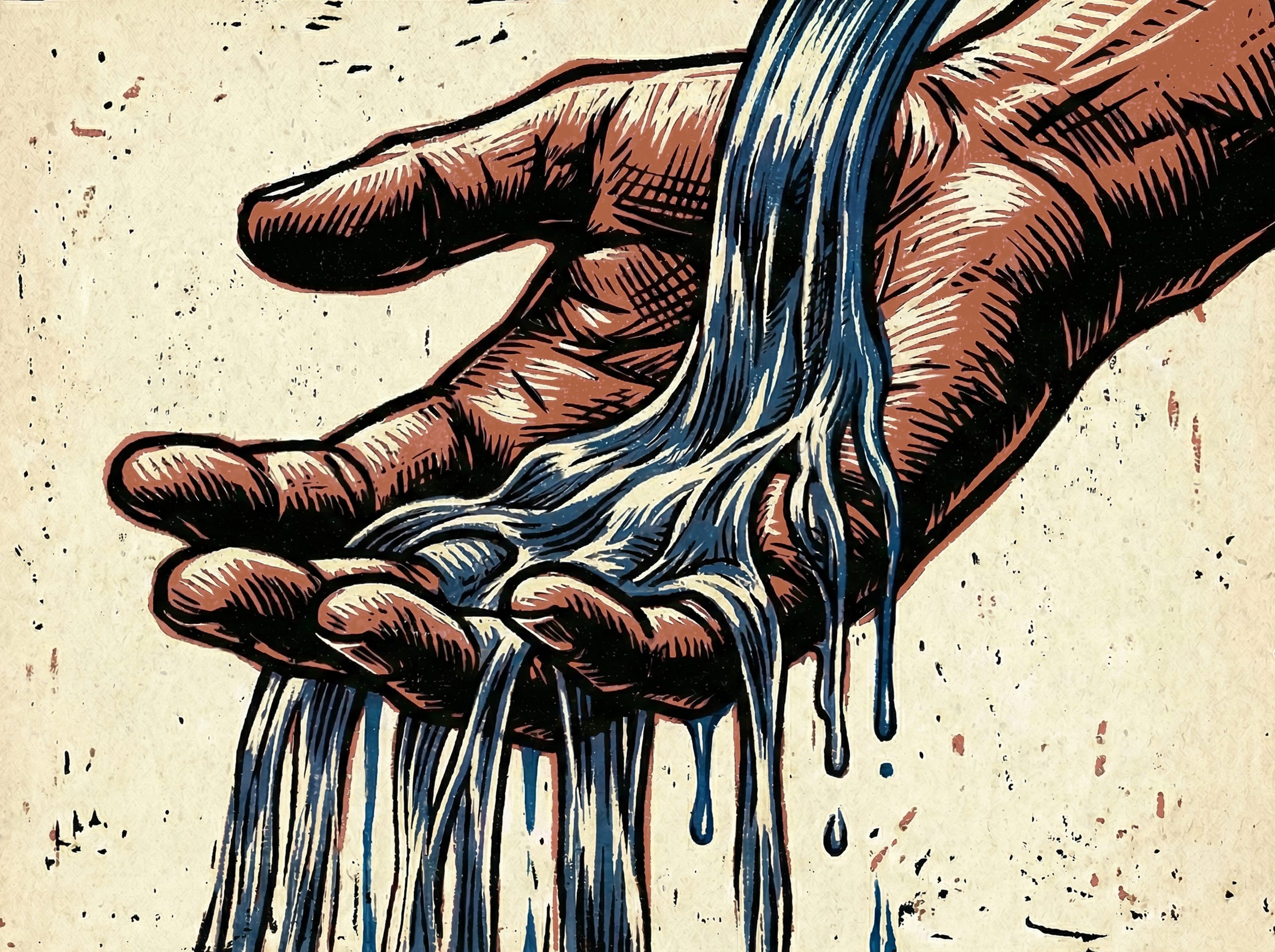
The things I gripped hardest slipped through my fingers. The things I received with open hands bore fruit.
The Illusion I Was Living
For most of my career, I operated under an assumption so deep I never examined it: my business was mine. I built it. I controlled it. Its outcomes depended on my strategy, my effort, my grip.
This felt obvious. Responsible, even. Isn’t this what entrepreneurs do? We identify opportunities. We build products. We execute strategies. We make things happen.
Except I wasn’t making things happen. Not really.
When I finally looked honestly at the pattern of my career—not the stories I told myself, but the actual evidence—I saw something I hadn’t wanted to see. My grip wasn’t producing what I thought it was producing. The outcomes I’d worked hardest for rarely materialized. The outcomes that actually sustained my business and family had arrived through doors I didn’t open, relationships I didn’t engineer, timing I didn’t control.
Ownership was always an illusion. Not just theologically—functionally.
I thought I was holding something. I was clenching my fist around water.
Two Ways to Hold a Business
There are two fundamentally different postures toward the work you’re building. From outside, they can look identical—same activities, same decisions, same long hours. From inside, they’re entirely different.
Ownership says: This is mine. I built it. Its success validates me. Its failure destroys me. Everything depends on my grip.
Stewardship says: This is God’s, entrusted to me for a season. My job is faithfulness. His job is outcomes.
Here’s what I’ve learned: the first posture doesn’t just feel different. It doesn’t work. The grip is grasping at something you were never actually controlling.
But wait—
Doesn’t the Bible Honor Hard Work?
I can hear the objection forming. Scripture talks about diligence. About working heartily as for the Lord. About the ant storing up in summer. The Proverbs 31 woman works vigorously; her arms are strong for her tasks.
Is this just spiritualized passivity? Sit back, pray hard, wait for God to drop opportunities in your lap?
No. But I had to understand what work actually does—and what it doesn’t.
What Work Can’t Do
I’ve read Psalm 127 dozens of times. I’m only now starting to understand it.
“Unless the LORD builds the house, those who build it labor in vain. It is in vain that you rise up early and go late to rest, eating the bread of anxious toil; for he gives to his beloved sleep.”
I always read this as a call to work less—don’t be a workaholic, trust God, get some rest. That’s not wrong, but it’s not the point either.
The contrast isn’t between diligence and laziness. It’s between two entirely different theories of how outcomes happen.
One theory: you rise early, stay late, eat the bread of anxious toil—because everything depends on your effort. Your grip produces the house.
Other theory: the LORD builds the house. You participate. You work. But the building itself—the outcome, the fruit—comes from Him.
Paul said it plainly: “I planted, Apollos watered, but God gave the growth. So neither he who plants nor he who waters is anything, but only God who gives the growth” (1 Corinthians 3:6-7).
Notice: Paul planted. Apollos watered. They worked. This isn’t passivity. But they didn’t produce the growth. That came from somewhere else.
And because it comes from somewhere else, you can actually rest. Not because you’ve worked hard enough to earn it, but because the outcomes were never yours to manufacture.
He gives to his beloved sleep. The beloved receives what the anxious striver cannot achieve.
The owner can’t stop. Everything depends on him. If he pauses, it all falls apart. The steward can rest because the Owner never sleeps.
So what was I actually gripping all those years? What did I think my striving was producing?
Even the Resources Aren’t Yours
It goes deeper than outcomes.
When David gathered materials for the temple, the offering was staggering—gold, silver, bronze, iron, wood, precious stones. He had rallied Israel to give generously for God’s house. By any measure, it was an impressive accomplishment.
Listen to how David talked about it:
“Yours, O LORD, is the greatness and the power and the glory and the victory and the majesty, for all that is in the heavens and in the earth is yours... Both riches and honor come from you, and you rule over all.”
Then: “But who am I, and what is my people, that we should be able thus to offer willingly? For all things come from you, and of your own have we given you“ (1 Chronicles 29:11-14).
David looked at enormous generosity—wealth he had gathered, offerings his people had given—and his response wasn’t “look what I’ve done.” It was “we’re just returning what was already yours.”
The gold was God’s before David touched it. The capacity to give was God’s before Israel exercised it. Even the willingness—”that we should be able thus to offer willingly”—came from God.
Of your own have we given you.
You cannot give God anything that didn’t come from Him first. You cannot build anything with resources He didn’t provide.
This reframes every act of generosity. The owner gives reluctantly from what’s “his”—every gift feels like loss. The steward manages generosity as part of the mandate. The resources were never his to hoard.
I’m not giving away what’s mine. I’m releasing what was always His.
But What About When Everything Falls Apart?
Fine, you might say. I can hold loosely when things are stable. When the business is healthy. When there’s margin to be generous and rest to be taken.
But what about when the entrustment is taken? What about when everything collapses—not because you failed, but because circumstances outside your control reshaped everything overnight?
Can the stewardship posture survive catastrophe?
The Posture That Holds
Job lost everything in a day. Livestock. Servants. Children. Wealth accumulated over a lifetime—gone in hours.
His response: “Naked I came from my mother’s womb, and naked shall I return. The LORD gave, and the LORD has taken away; blessed be the name of the LORD” (Job 1:21).
Not “I earned and lost.” Not “I built and it was destroyed.”
The LORD gave. The LORD has taken away.
Even in catastrophe, Job held the stewardship posture. What he had possessed was never ultimately his. It came from God’s hand. It returned at God’s will. And even in grief—even with his children dead—he could bless the name of the LORD.
Because his identity wasn’t buried in the rubble.
The owner is destroyed when the business fails. His identity was fused with it. The steward grieves—loss is real, and grief is appropriate—but his identity remains intact. He was faithful with what was entrusted. Now the entrustment has changed. He is still held by the God who gives and takes away.
I think about this when I imagine losing what I’ve built. Could I bless the name of the LORD? Only if my identity isn’t buried in the rubble. Only if I’m holding loosely enough that losing doesn’t destroy who I am.
But What About the Things We Love Most?
There’s one more test. The hardest one.
It’s easy enough to hold loosely to things you don’t care much about. Peripheral projects. Secondary revenue streams. Work you could take or leave.
But what about the thing you’ve waited longest for? Worked hardest for? Loved most deeply? The thing that feels like it is you?
Can you hold that with open hands?
The Ultimate Test
God promised Abraham a son. Abraham waited decades. Finally, Isaac came—the child of promise, the heir through whom all nations would be blessed. Everything Abraham hoped for, wrapped up in this boy.
Then God said: “Take your son, your only son Isaac, whom you love, and go to the land of Moriah, and offer him there as a burnt offering” (Genesis 22:2).
Abraham went. He built the altar. He bound his son. He raised the knife.
And God stopped him: “Now I know that you fear God, seeing you have not withheld your son, your only son, from me.”
Abraham held even the promise with open hands. The thing he’d waited longest for, prayed hardest for, loved most deeply—he was willing to return it to the Giver.
This is the ultimate test of stewardship. Not holding loosely to things you don’t care about. Holding loosely to the thing you care about most. Because even that—especially that—came from God’s hand and remains under God’s authority.
God gave Isaac back. But Abraham didn’t know He would. Abraham walked up that mountain prepared to release what mattered most.
That’s the posture.
The Counterfeits Exposed
Now I see what I couldn’t see before. The counterfeits I’ve written about—prosperity, prestige, power—they’re not just sinful. They’re futile.
Prosperity-grasping assumes your accumulation creates security. But your accumulation never created security. God provides or doesn’t.
Prestige-performing assumes your achievement creates worth. But your achievement never created worth. That question was settled at creation and confirmed at the cross.
Power-clutching assumes your control creates outcomes. But your control never created outcomes. You were gripping a steering wheel that wasn’t connected to anything.
The counterfeits promise what they cannot deliver. They whisper that you’ll finally be secure, finally be significant, finally be in control—if you just grasp a little harder. But it never arrives. It was never going to.
When you stop believing the lie, the grip relaxes. Not through willpower. Through seeing clearly.
How This Actually Happens
I need to say this clearly: I didn’t achieve this posture. I couldn’t have. The owner-identity was too fused with my sense of self. You can’t unclench your own fists when you’re convinced your survival depends on your grip.
This is death and resurrection.
The old self—the self that found identity in building, security in accumulation, worth in achievement—that self has to die. And you can’t kill it. It’s too woven into everything you are.
But in Christ, you’ve already died. “I have been crucified with Christ. It is no longer I who live, but Christ who lives in me” (Galatians 2:20). The death has happened. The new self—the self that receives instead of grasps, trusts instead of controls, rests instead of strives—is being formed in you by the Spirit.
Christ’s own posture becomes available to you. He didn’t grasp equality with God but emptied Himself (Philippians 2:6-7). He received everything from the Father’s hand—His mission, His timing, His path, even the cup of suffering. “Not my will, but yours be done.”
United to Him, His trust becomes your trust. His open hands become your open hands. Not overnight. Not perfectly. But really.
The Freedom I’ve Found
A few years ago, circumstances outside my control reshaped my business dramatically. It felt like the ground giving way.
But that season opened a door to something I couldn’t have planned—writing, teaching, building Wellstone Collective. Work that feels more aligned with calling than anything I’ve done in twenty years of entrepreneurship.
I didn’t manufacture this. I couldn’t have. My best strategies never produced anything this good.
What I’ve learned—what I’m still learning—is that God’s outcomes are better than mine. The paths I wouldn’t have chosen lead to destinations I couldn’t have imagined. The things I gripped hardest produced the least fruit. The things I received with open hands have borne abundantly.
So why do I keep trying to own what I was never controlling?
Your business isn’t yours. That’s not burden—it’s freedom. The outcomes were never yours to manufacture. The security was never yours to create. The worth was never yours to earn.
You can stop pretending. You can open your hands. You can plant and water, then trust the God who gives the growth.
He’s better at this than you are.
What are you gripping right now that you’ve never actually controlled? What would it look like to hold it as steward rather than owner?
Subscribe to receive weekly reflections on refusing empire and building as altar.
Wow - this post really resonates with me in this current moment. Stewardship is so crucial and beneath that is SURRENDER - letting go.