

The Posture of Open Hands
I spent three months gripping a deal I knew wasn't right. When it finally fell apart, relief arrived before disappointment—and a question surfaced: Whose business is this, actually?

I once spent three months pursuing a deal I knew wasn’t right.
The signs were there from the first meeting. The client wanted a scope we couldn’t deliver in the timeframe they demanded—and when I raised concerns, the room went cold. “We’ve talked to other firms,” the lead contact said, not looking up from his phone. “They didn’t have these kinds of reservations.”
I should have walked out. My senior developer had said as much before we jumped on the conference call. “This has red flags all over it.” He was right. I knew he was right. But the number on the proposal was significant—significant enough to cover our gap for the quarter, significant enough to make the investor update feel confident rather than anxious, significant enough that I could stop checking the bank balance every morning before coffee.
So I stayed. And I kept pushing.
Over three months, I adjusted proposals—each revision conceding something I’d said was non-negotiable the week before. I shortened timelines I knew were already aggressive. I agreed to deliverables that made my team go quiet in a way that meant they’d stopped arguing and started updating their résumés. Every concession felt small in isolation. Together, they were surrender dressed as negotiation.
The worst part wasn’t the concessions. It was the story I told myself about them. This was just good salesmanship. Just persistence. Just faith that it would work out. I’d learned to name the counterfeits in other people’s callings—but I couldn’t see the grasping in my own grip.
The grip was so tight I couldn’t see what I was holding.
When they finally said no—a form email, after three months of meetings—relief arrived before disappointment. Not relief that the pressure was over. Relief that the grip had been pried open by someone else’s hand, because mine wouldn’t unclench on its own.
And in that unexpected relief, a question surfaced: Whose business is this, actually?
I’d counted the cost of faithful entrepreneurship—or thought I had. But counting the cost is one thing. Releasing the grip is another.
The answer I’d been living said: mine.
The answer Scripture gives is different.
You don’t own your business—you steward it with open hands under Christ’s lordship, which transforms every decision into worship and every outcome into occasion for trust.
Ownership vs. Stewardship
There are two fundamentally different postures toward a business: ownership and stewardship.
From outside they look similar—same activities, same decisions, same spreadsheets and meetings and product launches. Inside they’re radically different. And they produce different trajectories.
Ownership says: This is mine. I built it. I can do what I want with it. Its success validates me. Its failure destroys me. I will fight to protect it, sacrifice to grow it, never let it go. It belongs to me because I earned it.
Stewardship says: This is God’s, entrusted to me for a season. I’m responsible to manage faithfully under His direction. Its success is His provision. Its failure is under His sovereignty. My identity is separate from it. I will serve it while it’s entrusted to me. I will release it when He directs.
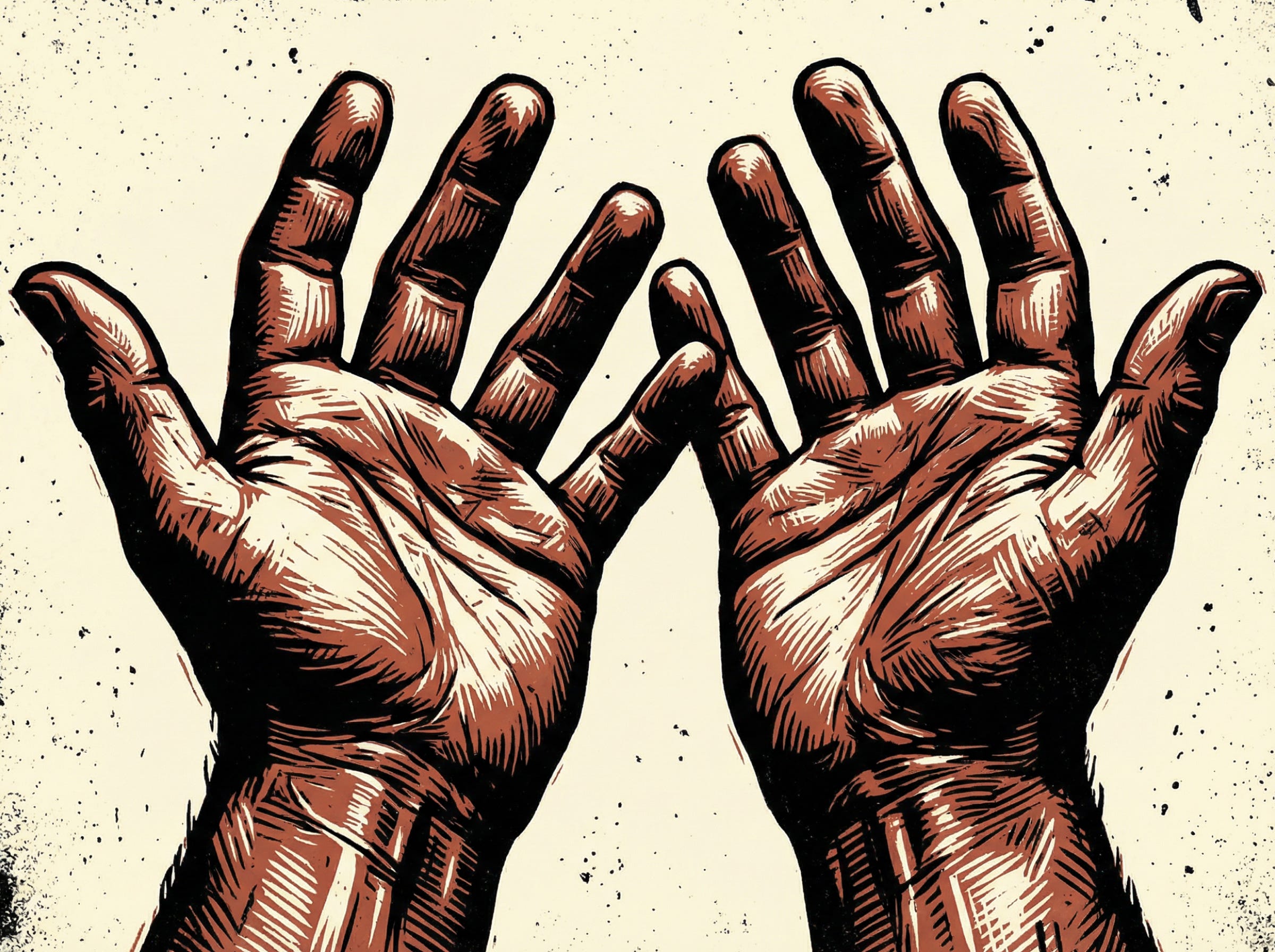
The grip is the tell. The owner’s fist is closed. The steward’s hands are open.
But what does this actually look like—not as a framework, but as a lived reality? Scripture doesn’t give us a single illustration. It gives us three, and each one goes deeper than the last.
David’s Prayer
“The earth is the LORD’s and the fullness thereof, the world and those who dwell therein” (Psalm 24:1). Everything. Not “the spiritual things belong to God and the material things belong to you.” The earth and its fullness. Your business is part of that fullness—your revenue, your team, your intellectual property, all part of what belongs to God.
David understood this—in a moment when everything in him could have justified the opposite.
Picture the scene. Israel had gathered materials for the temple—gold, silver, bronze, iron, wood, onyx, precious stones of every kind. The accumulation was staggering. Piles of wealth donated freely by a people caught up in the vision of building God’s dwelling place. David himself had given “over and above” from his private treasury—his personal fortune laid out for all to see.
This was the moment for a founder’s speech. The moment to stand before the assembly and say what every builder wants to say: Look what we’ve accomplished. Look what I’ve sacrificed. Look at the vision I cast and the resources I gathered and the people I inspired. By any measure, David had earned the right to take credit.
Instead, he prayed:
“Yours, O LORD, is the greatness and the power and the glory and the victory and the majesty, for all that is in the heavens and in the earth is yours. Yours is the kingdom, O LORD, and you are exalted as head above all. Both riches and honor come from you, and you rule over all...
“But who am I, and what is my people, that we should be able thus to offer willingly? For all things come from you, and of your own have we given you... O LORD our God, all this abundance that we have provided for building you a house for your holy name comes from your hand and is all your own.” (1 Chronicles 29:11–14, 16)
Notice what David didn’t say. He didn’t say “Look what Israel has given you, Lord.” He didn’t say “We’ve been generous.” He didn’t say “We’ve sacrificed.” He said of your own have we given you. The most lavish offering David could imagine was still just returning what was already God’s.
“What do you have that you did not receive?” Paul would later ask. “If then you received it, why do you boast as if you did not receive it?” (1 Corinthians 4:7). David anticipated the answer by a thousand years. There was nothing to boast about. You can’t give God what’s already God’s.
Ownership was always an illusion. David’s prayer doesn’t transfer title from Israel to God—it reveals that the title was never Israel’s to hold.
The steward’s posture begins here: recognizing that everything in your hands was placed there by Another and remains His throughout your custody. Even your most sacrificial giving is just returning what was already God’s.
But David had it easy.
The giving was voluntary. The celebration was genuine. Everything was going right—a kingdom at peace, a people united, wealth overflowing. It’s simple to hold things with open hands when your hands keep getting filled.
What about when everything is stripped away?
Job’s Declaration
Job’s circumstances were the opposite of David’s celebration.
In a single day he lost everything—oxen and donkeys stolen by raiders, sheep and servants consumed by fire from heaven, camels taken by Chaldeans, and then—unspeakably—all ten of his children killed when a great wind collapsed the house where they were feasting. His response:
“Naked I came from my mother’s womb, and naked shall I return. The LORD gave, and the LORD has taken away; blessed be the name of the LORD” (Job 1:21).
Naked I came... and naked shall I return. Paul would later echo the same reality: “We brought nothing into the world, and we cannot take anything out of the world” (1 Timothy 6:7). However tightly you grip it now, the grip releases eventually. Everything between arrival and departure is borrowed.
Not “I earned and lost.” Not “This was mine and now it’s gone.” The LORD gave, and the LORD has taken away.
Even in catastrophic loss—loss beyond what most of us will ever face—Job held stewardship posture. The children, the wealth, the health (which would go next)—all were given. All could be taken. Blessing the Lord’s name remained possible regardless.
Loss is the test that reveals whether you actually believe what David prayed. It’s easy to say “everything belongs to God” when everything is going well. David’s insight cost him nothing—he kept his kingdom, his throne, his son. Job’s declaration cost him everything. Stewardship is a posture that must survive catastrophe, not just plenty.
Can you bless the name of the Lord if He takes away what you’re building? If your business fails tomorrow—not because of sin, not because of foolishness, just because God in His inscrutable sovereignty allows it to collapse—can you say “The LORD gave, and the LORD has taken away; blessed be the name of the LORD”?
If not, you may be stewarding God’s business with owner’s hands.
David returned wealth. Job endured loss. But neither was asked for the one thing that changes everything—the thing through which all future blessings flow.
Abraham’s Open Hands
Abraham faced the most searching test of stewardship posture in Scripture.
God gave Isaac. He was the child of promise, born to parents who were well past childbearing years. Everything Abraham hoped for—the nation God promised, the land, the blessing to all families of the earth—flowed through Isaac. Isaac was not just a son; he was the future.
Then God said: “Take your son, your only son Isaac, whom you love, and go to the land of Moriah, and offer him there as a burnt offering on one of the mountains of which I shall tell you” (Genesis 22:2).
Abraham went. Early the next morning—no delay, no negotiation. He saddled his donkey, took Isaac and two servants, and went toward Moriah.
He built the altar. He arranged the wood. He bound his son and laid him on the altar. He raised the knife.
And God stopped him—provided a ram in the thicket, spared the boy, reiterated the blessing.
But the test revealed something that transcends everything David prayed and everything Job endured. David’s prayer dissolved the category of ownership—everything was already God’s. Job’s declaration survived the catastrophe of loss—even stripped of everything, the Lord’s name remained blessed. But Abraham was asked to release something that went beyond resources entirely. Isaac wasn’t wealth to be returned or loss to be endured. Isaac was the future—the channel through which every promise of God would flow. To release Isaac was to release not just a son but an entire horizon of hope.
Stewardship at its deepest isn’t about resources at all. It’s about trusting God with the future—releasing the thing through which all other blessings flow. The open hand is ultimately an act of faith in God’s character.
The author of Hebrews says Abraham “considered that God was able even to raise him from the dead” (Hebrews 11:19). However the theology worked in Abraham’s mind, he trusted God enough to offer back what God had given. This is stewardship as worship—not the management of assets, but the surrender of the future to the God who holds it.
Your business is not Isaac. But can you hold it the way Abraham held Isaac—received with joy, released if required, trusting that the God who gave can also restore?
What Open Hands Do
If stewardship were only a posture of the heart, it could become passivity dressed as piety. But open hands aren’t idle hands.
The parable of the talents shows what God expects from stewards. A master entrusted his property to three servants—five talents, two talents, one talent, each according to his ability. Then he went away (Matthew 25:14–15). When he returned, two servants had doubled their talents. His response to both: “Well done, good and faithful servant. You have been faithful over a little; I will set you over much. Enter into the joy of your master” (Matthew 25:21). The same commendation for both. Faithfulness, not scale, was the measure.
I can hear the objection, because I’ve raised it myself: If I’m not the owner, why would I fight for it? Doesn’t stewardship just take the edge off—remove the hunger that makes entrepreneurs entrepreneurs?
Look at the third servant. He buried his master’s money—returned exactly what he was given, nothing lost, nothing gained. He wasn’t commended for careful stewardship. He was condemned: “You wicked and slothful servant.” The master’s fury wasn’t about lost capital. It was about wasted opportunity. The servant treated his master’s resources as a liability to be protected rather than a trust to be deployed.
Open hands don’t clutch. But they don’t go limp either. The steward who understands that everything belongs to God works with the freedom of someone who answers to a Master who sees everything—whose standard is external, whose evaluation isn’t “did I get what I wanted?” but “did I do what He entrusted me to do?”
The edge you’re afraid of losing isn’t diligence. It’s anxiety. And anxiety was never the engine you thought it was. It’s the owner’s fuel—and it burns everything eventually.
Here’s the surprise: stewardship is more freeing than ownership. The owner lies awake because everything depends on him. The steward can sleep because the Owner never does. The owner panics when things go wrong because his whole self is on the line. The steward grieves but doesn’t despair because his self isn’t in the balance. The owner can’t enjoy success because success only raises the stakes for next time. The steward receives success as gift—held loosely, enjoyed freely.
The prison you thought was freedom is ownership. The constraint you feared is actually liberty.
I’m still learning this. The owner-instinct doesn’t vanish when you name it. Some mornings I catch myself checking the numbers before I’ve talked to God—gripping the dashboard with white knuckles, calculating trajectories, running scenarios as if the whole enterprise depends on whether I can think hard enough to make it work. The fist still tries to close. After years of building, the reflex runs deep.
But I recognize it faster now. I can feel the grip tightening before it locks. And increasingly—not always, but more often than before—I can bring it to Christ before the fist seals shut. This is yours. This was always yours. I’m returning what I’ve been holding.
The hands don’t stay open on their own. They have to be opened again and again, sometimes hourly, by the One whose hands were opened on the cross.
The seventy-two were sent with this posture.
“Carry no moneybag, no knapsack, no sandals” (Luke 10:4).
Why? Because they weren’t owners accumulating; they were stewards depending. They couldn’t grip what they didn’t have. They couldn’t possess what they didn’t carry.
Open hands can receive what closed fists cannot. The seventy-two entered each town with nothing—which meant they could receive provision freely, without the confusion of “is this mine or His?” The answer was obvious: everything they received was gift.
Your hands may be fuller than theirs. You may have a moneybag, a knapsack, the business equivalent of sandals. But the posture should be the same: open. Ready to receive. Ready to release. Gripping nothing.
You are sent—we established that. You are already beloved—identity secured before outcomes. You’ve heard the call and learned to distinguish it from the counterfeits. You’ve counted the cost and found the kingdom worth more than the metrics.
Now here is the posture that makes all of it sustainable: open hands.
You’re not the owner. You never were.
Everything in your hands was placed there by Another, remains His throughout your custody, and will eventually be released. Your job is faithfulness. His job is everything else.
Carry no moneybag.
Hold nothing so tightly it can’t be returned.
Trust the One who gives, who takes away, and whose name remains blessed regardless.
Open your hands.
What are you gripping right now that you’re afraid to let God have?
Subscribe to receive reflections on faithful business in a predatory marketplace.