

The Kingdom That Has Come
A friend lost everything and his church showed up—not with advice, but with groceries and mortgage payments. I watched a different economy in action and couldn't stop asking:where does that come from?

I watched a different economy once, and it wrecked me for the normal one.
A friend—a fellow entrepreneur—lost his biggest client without warning. Not a gradual decline. A phone call on a Tuesday: “We’re going in a different direction.” Sixty percent of his revenue, gone between breakfast and lunch. He sat in his truck in the parking lot afterward and called his wife. Then he called his pastor.
What happened next didn’t follow any logic I’d been taught.
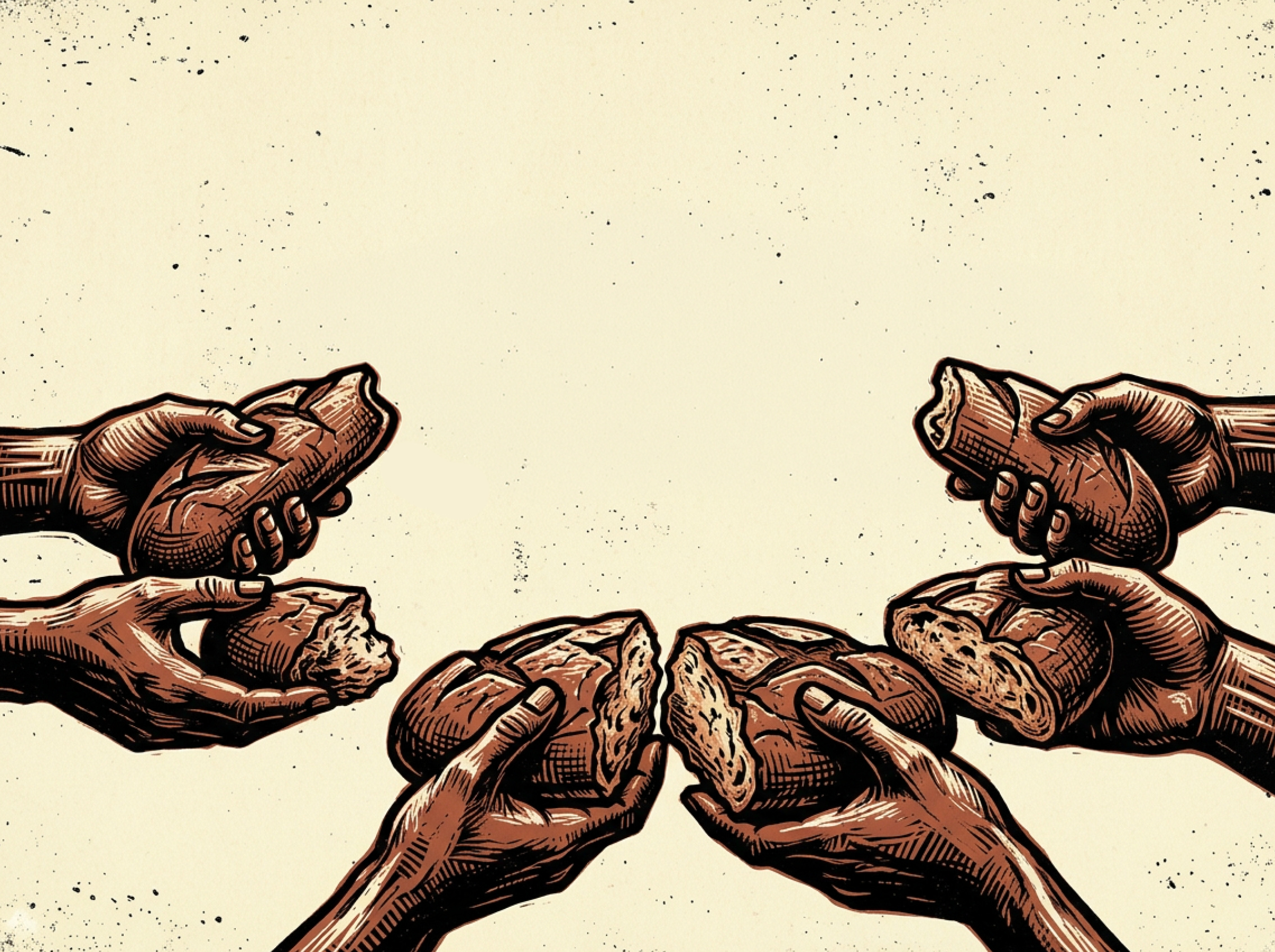
His church showed up. Not with advice—everyone has advice. Not with platitudes about God’s sovereignty—though that was true and would matter later. They showed up with groceries. One elder quietly covered his mortgage for two months. Another business owner in the congregation referred three clients in a week—not as charity, but because the work was genuinely good and the needs were real. His small group restructured their Tuesday nights around his family for a season. No one tracked the cost. No one kept a ledger.
I remember standing in his kitchen three weeks after the call, watching people move through the house like it was the most natural thing in the world—food appearing, kids being picked up, someone mowing the lawn—and feeling profoundly disoriented.
This wasn’t networking. It wasn’t strategic generosity with an expected return. It wasn’t even charity in the way I understood it—the benevolent reaching down to the unfortunate. It was something else entirely: a community operating by completely different logic. Value flowing toward need rather than toward opportunity. Resources moving without extraction. People treating someone else’s crisis as their own responsibility.
I’d been in business for fifteen years by then. I knew how economies worked. Supply and demand. Value exchange. Mutual self-interest as the engine of commerce. What I was watching didn’t fit any of those categories.
Where does that come from?
A Kingdom with an Economy
Jesus came announcing a kingdom.
We hear that word and think “spiritual realm”—some ethereal domain of prayer and worship that runs parallel to real life without intersecting it. But that’s not what Jesus meant. When He said “The kingdom of God is at hand” (Mark 1:15), He was announcing a new order breaking into the present world. A kingdom with a king, citizens, laws—and an economy.
Economy means household management. It’s how a household orders its resources, its exchanges, its relationships. And God’s kingdom has a way of managing the household that is fundamentally different from anything the marketplace teaches.
This isn’t ethics bolted onto business. It’s not “be nicer while doing the same thing.” It’s an entirely different system—a different vision of what value is, how it flows, what commerce is for. The kingdom of God has an economy, and faithful business is participating in that economy while still living in Babylon’s.
“Seek first the kingdom of God and his righteousness,” Jesus said, “and all these things will be added to you” (Matthew 6:33). The order matters. Not “seek these things and add the kingdom.” Not “seek the kingdom and these things simultaneously.” Seek the kingdom first. Everything else follows.
But what does this economy actually look like? Where can we see it in action?
The Manna Paradigm
Before Israel had a temple or a marketplace or a monarchy, God gave them an economics lesson in the desert.
The people were hungry. They’d left Egypt—left slavery, yes, but also left the food that came with slavery. And in the wilderness between bondage and promise, they had nothing. So God provided manna.
“In the morning dew lay around the camp. And when the dew had gone up, there was on the face of the wilderness a fine, flake-like thing, fine as frost on the ground” (Exodus 16:13–14). Bread from heaven. Every morning. Exactly enough.
But watch the economics:
“Gather of it, each one of you, as much as he can eat... And the people of Israel did so. They gathered, some more, some less. But when they measured it with an omer, whoever gathered much had nothing left over, and whoever gathered little had no lack. Each of them gathered as much as he could eat” (Exodus 16:16–18).
Those who gathered much had nothing left over. Those who gathered little had no lack.
This is not how the marketplace works. In the marketplace, those who gather much have surplus. Those who gather little go without. Accumulation is the whole point. The manna economy inverted everything.
And there was one more rule: “Let no one leave any of it over till the morning” (Exodus 16:19). Some tried anyway—because of course they did. We always try to hoard. “But they did not listen to Moses. Some left part of it till the morning, and it bred worms and stank” (Exodus 16:20).
The manna couldn’t be hoarded. Accumulation was structurally impossible. The provision was daily, sufficient, and non-transferable to tomorrow.
This is how kingdom economics works. Not scarcity defended but abundance received. Not accumulation for security but daily dependence on provision. Not grasping for tomorrow but trusting that tomorrow’s bread will come tomorrow.
The Year of Jubilee would later enshrine the same principle into Israel’s national law—every fiftieth year, land returned to original families, debts cancelled, slaves freed (Leviticus 25). A built-in reset against permanent inequality. God’s economic vision: provision for all, limits on accumulation, regular redistribution.
But these were structures. What did the economy look like when it was embodied in community—when people actually lived it?
The Seven Marks
What are the marks of a kingdom economy? Not as a list to check off—that would be horizontal, just more information. Each mark flows from the one before it. Each one becomes possible because of what precedes it.
Generosity as posture. “You received without paying; give without pay” (Matthew 10:8). This is the manna lesson internalized. If everything you have is received—daily, from God’s hand—then generosity isn’t sacrifice. It’s the natural overflow of abundance. The first instinct becomes “how can I give?” not “how can I get?” You work backward from giving, not forward from taking.
This is where it starts—because until you experience yourself as a recipient of undeserved abundance, every other mark feels like constraint.
From generosity flows service as purpose. “Whoever would be great among you must be your servant” (Matthew 20:26). Jesus washed feet. Greatness is measured by service rendered, not wealth accumulated. Your business exists to serve neighbors—solving real problems, meeting real needs, creating real value. Not primarily to enrich you. Not primarily to build platform. The profit that allows continuation of service is welcome; the service itself is the point.
Service, genuinely offered, requires truth as foundation. “You will know the truth, and the truth will set you free” (John 8:32). You cannot truly serve someone while deceiving them. The kingdom economy operates on honest representation, transparent dealing, words matching reality. No manipulation, no false witness, no crafted deception. This isn’t merely ethical constraint—it’s how the kingdom works. Lies corrode trust. Truth builds it. Businesses built on truth participate in something more solid than those built on spin.
Truth demands justice as standard. “What does the LORD require of you but to do justice, and to love kindness, and to walk humbly with your God?” (Micah 6:8). Fair pricing. Honest value. Equitable treatment. Jubilee restored what had been lost. Gleaning laws ensured the poor could eat. No exploitation of the vulnerable. Justice isn’t constraint on profit; it’s the foundation of kingdom commerce. Unjust gain isn’t gain at all—it’s theft in slow motion.
Justice practiced consistently makes rest as rhythm possible. “Come to me, all who labor and are heavy laden, and I will give you rest” (Matthew 11:28). When you’re not grasping, not extracting, not defending unjust margins—you can stop. The kingdom economy includes Sabbath: regular stopping that declares provision comes from God, not ceaseless labor. The world says hustle harder. The kingdom says stop regularly. This isn’t laziness; it’s declaration. Your work doesn’t hold the world together.
Rest reveals what was there all along: contentment as freedom. “Godliness with contentment is great gain” (1 Timothy 6:6). The kingdom economy escapes the endless-more treadmill. Enough is actually enough. The world’s economy has no ceiling—more is always better, growth is always good, contentment is stagnation. The kingdom says: there’s a point where you have enough, and recognizing that point is wisdom, not failure.
And all of this flourishes in community as context. None of these marks work in isolation. Generosity requires recipients. Service requires neighbors. Truth requires relationships. Justice requires a commons. Rest requires trust that others will carry what you set down. Contentment requires people who affirm “enough” rather than shaming it.
The kingdom economy isn’t isolated individuals maximizing personal gain. It’s community where resources flow to meet needs. You don’t build alone. You don’t succeed alone. You don’t fail alone.
This is what I saw in my friend’s kitchen that night. Every mark operating at once, unconsciously, because the community had been formed by a different economy. Not because they’d memorized a list—because they’d been shaped by a King.
No Needy Person Among Them
Now look at what happens when these marks converge. Look at the summit—the moment in Scripture where the kingdom economy is fully embodied:
“They devoted themselves to the apostles’ teaching and the fellowship, to the breaking of bread and the prayers. And awe came upon every soul, and many wonders and signs were being done through the apostles. And all who believed were together and had all things in common. And they were selling their possessions and belongings and distributing the proceeds to all, as any had need. And day by day, attending the temple together and breaking bread in their homes, they received their food with glad and generous hearts, praising God and having favor with all the people” (Acts 2:42–47).
And then, a few chapters later, the summary: “There was not a needy person among them, for as many as were owners of lands or houses sold them and brought the proceeds of what was sold and laid it at the apostles’ feet, and it was distributed to each as any had need” (Acts 4:34–35).
There was not a needy person among them.
This is the kingdom economy in full flower. Generosity flowing freely. Service as default. Truth taught and lived. Justice in distribution. Rest in glad hearts. Contentment in receiving food with gratitude. Community as the context for all of it.
And notice what happened around this community. They had “favor with all the people.” The world looked at them and was drawn in. Not by their marketing strategy. Not by their conversion optimization. Not by manufactured urgency or psychological pressure. By the sheer beauty of a community where no one was in need.
“And the Lord added to their number day by day those who were being saved” (Acts 2:47).
The kingdom economy didn’t just meet needs. It was beautiful. And beauty draws. The world looked at the early church and saw something it couldn’t explain and couldn’t resist—a community operating by different logic, where value flowed toward need, where generosity was instinct, where no one was left behind.
This is what’s possible. This is what’s real.
Not a theory of commerce. Not an aspirational framework. An actual economy, established by an actual King, demonstrated by an actual community—and available to anyone willing to operate by its logic.
The Outpost
Your business is not the early church. I know that. Mine isn’t either. We operate in Babylon’s marketplace with Babylon’s currency, subject to Babylon’s regulations, competing with Babylonians who play by Babylon’s rules. The kingdom economy has not yet fully come. We live between the “already” and the “not yet.”
But what you build can be an outpost.
An outpost of generosity in an economy of extraction. An outpost of service in a marketplace of self-interest. An outpost of truth where spin is the native language. An outpost of justice where exploitation is standard practice. An outpost of rest in a culture of relentless hustle. An outpost of contentment in a system that worships growth. An outpost of community in a world of isolated competitors.
Not perfectly—that comes later, when the King returns and makes all things new. But directionally. Recognizably. Enough that someone watching would feel the disorientation I felt in my friend’s kitchen: This operates by completely different logic. Where does that come from?
“Give, and it will be given to you,” Jesus said. “Good measure, pressed down, shaken together, running over, will be put into your lap” (Luke 6:38). This is the kingdom’s promise—not that generosity is a technique for getting more, but that the kingdom’s economy is fundamentally abundant. You can afford to give because the supply isn’t limited by what you can accumulate. It’s sustained by a King who never runs out.
You are sent—as a lamb, yes, among wolves. But you’re not sent empty. You carry the economy of a kingdom that has already come and is still coming. What you build participates in something that will outlast every Babylonian empire, every marketplace trend, every business model that trades in “human souls.”
The kingdom of God has an economy. And you’re invited into it.
What would change in your business this week if you operated from abundance received rather than scarcity defended?
Subscribe to receive reflections on faithful business in a predatory marketplace.