

The God Who Sends
You're not funding the mission. You are the mission. God doesn't tolerate your work. He sent you to it.

“So what do you do?”
The question came at a church dinner. The man asking was a missionary—just returned from ten years in Southeast Asia. He had stories of persecuted believers, of secret house churches, of risking his life to bring the gospel to unreached people.
“I run a software consultancy.”
I said it the way you confess something slightly embarrassing. I watched his face for what I knew would come—the subtle shift, the polite nod, the almost imperceptible downgrade in interest. He was in the real work. I was in the marketplace.
“That’s great,” he said, already scanning the room. “We need people who can fund the work we are doing.”
Fund the mission. There it was. My place in the kingdom hierarchy: wallet. Checkbook for the real soldiers. Necessary but not sacred. Tolerated but not called.
I smiled and excused myself. And I believed him—because I already believed it myself.
The Hierarchy Nobody Names
There’s a hierarchy nobody states out loud.
Missionaries at the top. Pastors close behind. Then nonprofit leaders, campus ministers, those who work with the poor. These are the callings. These are the people who gave up the world to follow Jesus.
And then there’s you. Building software. Running a consultancy. Selling services. Secular work. The best you can hope for is to fund the real work, to make enough money that you can give generously to those actually serving God.
I lived inside this hierarchy for years. I saw my business as necessary but not sacred, permissible but not purposeful, tolerated by God but not delighted in.
Do you know what that does to you?
It hollowed out my work. Every proposal I wrote, every client I served, every problem I solved—none of it felt like it mattered to God. I’d pray before meetings and feel vaguely foolish, like I was bothering the Almighty with commerce when He had martyrs to attend to. I’d read about Bezalel filled with the Spirit, and some part of me would think: That was different. That was for the tabernacle. This is just software.
So I worked hard and gave generously and felt like a second-class citizen of the kingdom. I was the Martha who’d never be Mary. The hand who envied the eye. The one doing necessary things while others did beautiful ones.
I know now that I was wrong. But I didn’t just think wrongly—I felt wrongly, in my bones, every time I went to work. And maybe you do too.
The Exile I Created
Before I show you what I missed, let me sit in what I got wrong. Because the lie runs deeper than “business isn’t sacred.” The lie shaped how I experienced God Himself.
If my work didn’t matter to God, then eight to ten hours of my day were exile. I was away from His presence, doing tolerated things, waiting to return to the spiritual activities where He actually met me. Prayer was spiritual. Bible study was spiritual. Church was spiritual. Work was... work.
This meant most of my life was spiritually empty. I could encounter God on Sunday mornings and in my quiet times, but the bulk of my waking hours were neutral at best. I was a Christian who happened to work, not a Christian whose work was worship.
And because my work didn’t matter to God—or so I believed—I didn’t expect Him to care about the details. The difficult client wasn’t a discipleship opportunity. The ethical dilemma wasn’t a place to practice faithfulness. The success wasn’t glory to give Him, and the failure wasn’t suffering to share with Christ. Work was just work. A parenthesis in my spiritual life.
Do you see how impoverished this is? Do you feel how lonely?
The missionary at that dinner didn’t create my theology. He only confirmed it. I’d already exiled myself from the presence of God in my own vocation. I’d already declared my work spiritually meaningless. I was funding the mission because I couldn’t be the mission—or so I thought.
In the Beginning, God Worked
What I missed was right there at the beginning.
In the beginning, God worked.
“In the beginning, God created the heavens and the earth.” The Hebrew word bara—bringing something into existence, fashioning with purpose. And then the text shows us what divine work looks like: speaking and matter arranging itself, separating light from darkness, land from sea, ordering chaos into cosmos. Six days of productive labor.
This is not beneath God. This is God doing what God does.
He planted a garden. Fashioned a man from dust. Breathed life. Made animals and birds and swimming things. And when He surveyed what He’d made, He didn’t shrug with divine indifference. He examined His work like an artisan examining a finished piece: “And God saw that it was good.”
The God you serve is a God who works. Before sin, before fall, before any stain on creation—God was productive. He made things. He solved the problem of formlessness and void. He created value where there was none.
If work were beneath dignity, God wouldn’t do it.
The Invitation to Participate
Then He did something remarkable.
He could have maintained the garden Himself. He could have caused the plants to flourish without human intervention, the animals to arrange themselves, the whole system to run on divine autopilot while Adam simply existed in passive enjoyment.
Instead: He invited.
“The LORD God took the man and put him in the garden of Eden to work it and keep it” (Genesis 2:15). The Hebrew words suggest cultivation and protection—active engagement, not passive residence. Adam wasn’t placed in the garden to lounge. He was placed there to participate in what God was doing.
God didn’t need Adam’s help. He wanted it.
This changes everything. The dignity of productive labor isn’t a concession to a fallen world—it’s original equipment. It’s how God made us. Before thorns and thistles, before sweat and toil, before the curse made work painful—work was gift. Work was invitation. Work was participation in divine activity.
The curse made work toilsome; it didn’t make work fallen.
Now watch what happens when I stop seeing work as parenthesis and start seeing it as participation.
When you solve a genuine problem for a customer, you’re participating in God’s work of bringing order from chaos. When you create something beautiful and functional, you’re exercising the creativity He stamped into you at creation. When you provide employment for others, you’re enabling them to work and provide for their families. When you serve customers with excellence, you’re loving neighbors in the marketplace.
This isn’t baptizing ambition. This is recognizing what God actually made humans to do.
And it’s not just theological abstraction. It’s the difference between exile and presence. If my work is participation in God’s work, then God is with me in my work. Not tolerating it. Not waiting for me to finish so I can do something spiritual. Present. Interested. Pleased when I work well. Glorified when I serve faithfully.
Eight to ten hours of my day just went from empty to full.
The Spirit-Filled Craftsman
But here’s where it gets astonishing.
When God was building the tabernacle—His dwelling place among His people, the most sacred space in Israel—He spoke to Moses about who would do the work:
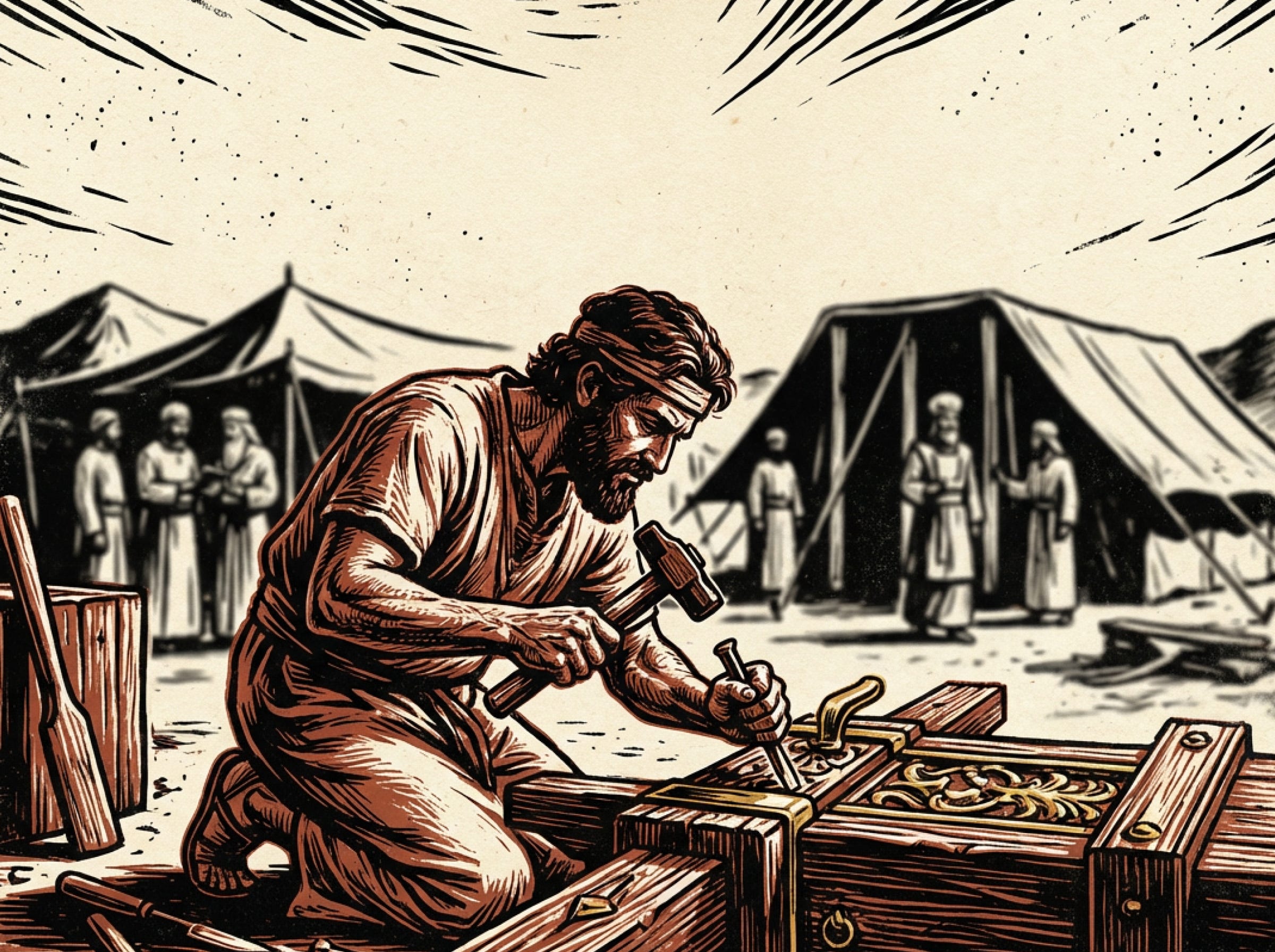
“See, I have called by name Bezalel the son of Uri, son of Hur, of the tribe of Judah, and I have filled him with the Spirit of God, with ability and intelligence, with knowledge and all craftsmanship, to devise artistic designs, to work in gold, silver, and bronze, in cutting stones for setting, and in carving wood, to work in every craft.” (Exodus 31:2–5)
The Spirit filled a craftsman. For what? For craftsmanship.
Not for preaching. Not for prophecy. Not for the religious roles we unconsciously elevate. For working gold and silver and bronze. For cutting stones and carving wood. For making beautiful and functional things.
The same Spirit who hovered over the waters at creation. The same Spirit who rested on prophets and kings. The same Spirit who would fill the apostles at Pentecost.
That Spirit filled a craftsman for the purpose of doing craft excellently.
This is God’s explicit testimony about skilled work: it can be Spirit-empowered calling. Bezalel wasn’t doing lesser work while the priests did the real ministry. His work was ministry. His craft served the dwelling of God. His skill honored the One whose image includes creativity.
The dichotomy between “spiritual work” and “secular work” dissolves here. It doesn’t survive contact with Bezalel.
Commerce as Kingdom Work
And it doesn’t survive contact with Lydia either.
She appears briefly in Acts 16: “A woman named Lydia, from the city of Thyatira, a seller of purple goods, who was a worshiper of God” (Acts 16:14). Purple cloth was expensive, traded among the wealthy. She was a businesswoman—a merchant, a trader, a dealer in luxury goods.
When Paul preached by the river, “the Lord opened her heart to pay attention to what was said by Paul.” She was baptized with her household. And immediately: “If you have judged me to be faithful to the Lord, come to my house and stay.”
Her commerce and her hospitality weren’t separate compartments. Her trade supported her household and enabled kingdom hospitality. The early church in Philippi would meet in her home—a home sustained by her commerce. Her business resources served the spread of the gospel.
Lydia didn’t abandon commerce to follow Jesus. Her business became integrated into her discipleship—not as necessary compromise, but as calling.
And Paul himself made tents.
The apostle who wrote half the New Testament, who planted churches across the Roman world, who was caught up to the third heaven and heard things that cannot be told—that Paul. He worked with his hands. He earned money through craft.
“And because he was of the same trade he stayed with them and worked, for they were tentmakers by trade” (Acts 18:3).
Was this distraction from ministry? Listen to how Paul spoke about it:
“You yourselves know that these hands ministered to my necessities and to those who were with me.” (Acts 20:34)
These hands ministered. Not “these hands earned money that funded ministry.” The work itself ministered. The tentmaking was service.
Paul could have demanded support from the churches—and sometimes he did accept it. But he chose to work, in part to model something: physical labor, commercial enterprise, skilled trade—these were demonstrations of gospel living, not departures from it.
Do you see what I missed at that church dinner?
I thought I was talking to someone in the real work while I was stuck in the necessary work. But Paul would have understood my consultancy differently than I did. Bezalel would have recognized skill offered to God. Lydia would have known that commerce can serve the kingdom.
The missionary wasn’t wrong that we need people who can fund the mission. But I was wrong to accept that as the limit of my calling.
Before you are an entrepreneur, you are sent—called by a God who speaks into vocation, who delights in productive work, and who invites you to join Him in cultivating the world.
Sent, Not Sidelined
This reframes everything.
If business were necessary evil—worldly distraction from spiritual things—then entrepreneurship would be compromise at best. Something to feel vaguely guilty about while the pastors and missionaries do what actually matters.
But that’s not the biblical picture.
God made a world that requires cultivation. Problems need solving. Value needs creating. Goods need exchanging. And He invites His people to participate in all of it—not as second-class citizens of the kingdom, but as sent ones. Ambassadors in the marketplace. Image-bearers exercising the creativity and productivity stamped into us at creation.
The question isn’t whether business can be calling. It can. Bezalel was Spirit-filled for craftsmanship. Lydia served the church through commerce. Paul’s tentmaking hands ministered.
The question is whether God is calling you to this—and whether you’re doing it as empire or as altar.
That’s a different question, one that requires honest examination of your own heart. Not all entrepreneurs have genuine callings. Some are running from something—pain, inadequacy, bosses they couldn’t stand. Some are grasping for something—security, significance, control. Some have simply never asked whether this is what God wants.
But if He is calling, He’s inviting you into something good. Not just tolerable. Not just morally permissible. Good—participation in His ongoing work of cultivating the world, serving neighbors, creating value.
The next time someone asks “so what do you do?” at a church dinner, I want to answer differently. Not with embarrassment. Not as confession of something lesser.
I want to answer the way Bezalel might have: I’ve been given skill by God to solve problems and serve people, and I offer my craft as worship.
I want to answer the way Lydia might have: I do commerce, and through it I provide hospitality for the saints and resources for the kingdom.
I want to answer the way Paul might have: These hands minister—to my necessities, to those I employ, to the customers I serve.
You are not relegated to the secular sphere while others do sacred work.
You are sent.
Subscribe to receive reflections on faithful business in a predatory marketplace.
I’m growing weary of the legalism disguised as "spirituality" in some churches. Being told you’re "robbing God" by working weekends, or that your income is cursed if you miss a CG group, is not the Gospel I know.
The God I serve is not restrictive—He calls us to worship Him in all areas of life, including our work.
Let’s be honest: Living out faith in the cutthroat marketplace is far more difficult than the comfort of a church pew. It’s there, amid tough decisions and fierce competition, that Christians are called to be salt and light. Our work, done with integrity, is our mission field.