

The Cathedral of Commerce
You're not just learning business—you're being formed into someone's disciple.

Last week, I told you about the night I realized my first response to business crisis wasn’t prayer—it was panic. That moment exposed what I was really trusting: money for peace, control for security, success for worth. I was grasping for prosperity, prestige, and power while calling it faithful stewardship.
But here’s the question I couldn’t answer then: How did I get there?
I was a Christian. I went to church. I read Scripture. I prayed. I genuinely wanted to honor God with my business. So how did I end up with a theological confession that said “Christ is Lord” and a practical allegiance that said “money is security”?
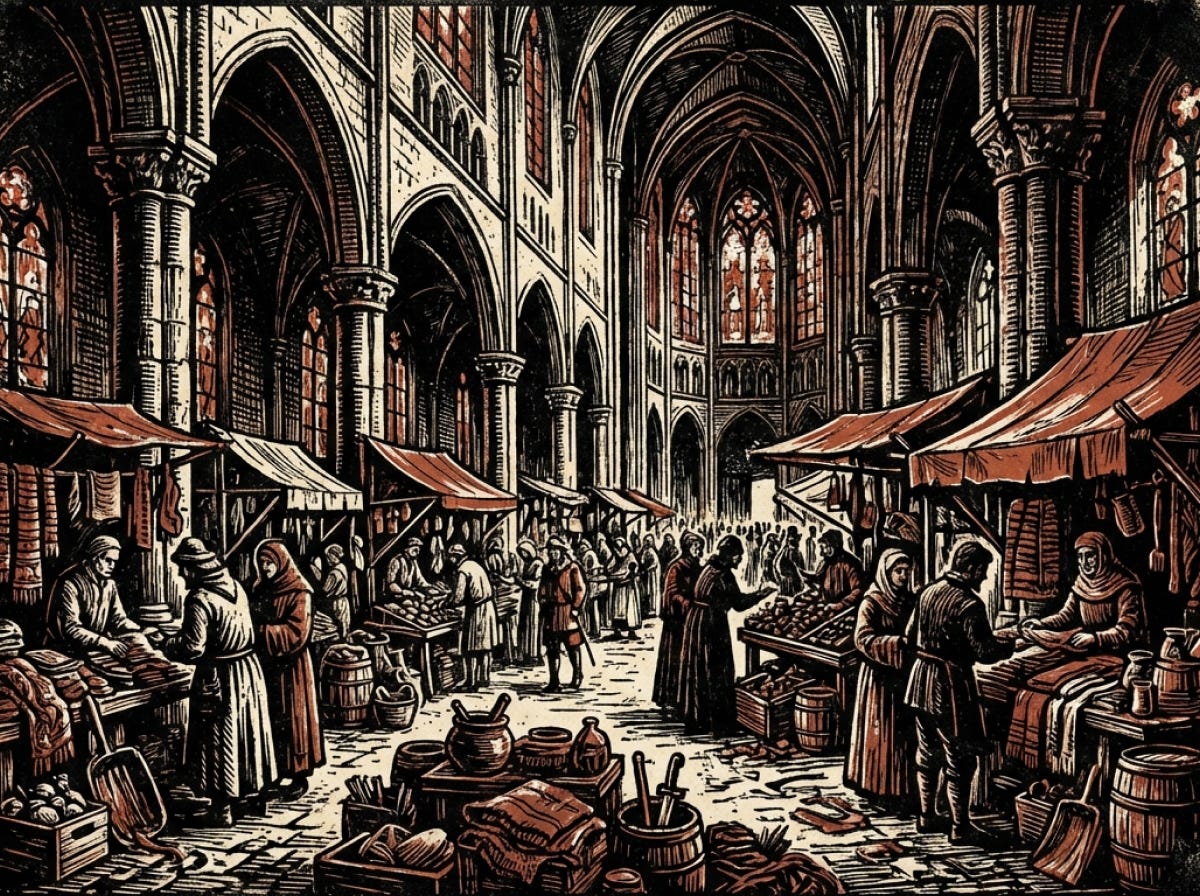
The answer is simpler and more disturbing than I realized: The marketplace is a cathedral of competing worship, and I was being catechized in a competing gospel every single day without even noticing.
The Marketplace is Making Disciples
You think you’re just learning business tactics. You’re not.
You think you’re consuming content to improve your skills. You’re not.
You think you’re building a company using neutral frameworks. You’re not.
You’re being discipled. Systematically. Daily. Into a vision of the good life that has nothing to do with Christ’s kingdom.
Every business book is a catechism. Every podcast is a sermon. Every framework is a formation tool. Every success story is a saint’s testimony. Every guru is a priest. Every milestone is a sacrament.
And all of it—all of it—is forming you.
Not just informing you. Forming you. Shaping your desires. Training your affections. Teaching you what to love, what to fear, what to trust, what to worship.
Here’s the truth: you are what you love. But you don’t choose what you love—you’re formed into loving by practices that shape your desires beneath the level of conscious thought. The question isn’t just what you believe intellectually, but what you’ve been trained to desire by your daily habits.
This is why trying harder doesn’t work. Why reading one more book about trusting God doesn’t change anything. Why your theological convictions and your practical decisions seem completely disconnected.
You can be theologically orthodox and practically pagan because while your mind affirms gospel truth on Sunday, your body is being trained Monday through Saturday to trust something else entirely.
The marketplace isn’t neutral ground where Christians apply biblical principles. It’s contested territory. A battlefield of competing formation. And most of us didn’t even know we were in a fight.
The Architecture of Formation
A cathedral isn’t just a building where worship happens. It’s a building designed to form worshippers. Everything about it—the soaring ceilings that make you feel small, the stained glass that teaches biblical stories, the acoustics that amplify the music, the altar that draws your eyes—is intentional formation.
You don’t have to consciously think “I’m being formed right now” for it to work. In fact, it works better when you don’t notice. The architecture does its work beneath conscious thought, shaping your imagination, training your desires, forming your vision of what’s real and what matters.
The marketplace functions exactly the same way.
It has its own architecture of formation. Its own rhythms that train your body. Its own catechisms that shape your mind. Its own gospels that capture your imagination. Its own priests who tell you what to believe. Its own sacraments that promise salvation.
Let me show you how it works.
The Daily Rhythms
The marketplace forms you through repeated practices—the habits and routines that train your body over time. You participate in them every day, often without realizing what they’re doing to you.
Morning ritual: You wake up. Before prayer, before Scripture, before breakfast—you check your phone. Email. Slack. Social media. Metrics. The first thing you do is bow before the altar of productivity and perform the ritual of staying connected, staying relevant, staying in control.
This isn’t neutral. It’s formative. You’re training your body: anxiety is normal, rest is wasteful, your worth comes from responsiveness. Every morning, the pattern repeats, and slowly—imperceptibly—you’re being shaped.
Midday obsession: Throughout the day, you check metrics compulsively. Revenue dashboard. Website traffic. Social media engagement. Not because you need the information—you checked an hour ago—but because the checking itself is habit. A ritual that promises: if you monitor closely enough, you can stay in control. The practice trains you to trust surveillance over sovereignty.
Evening scroll: Before bed, you scroll. Instagram success stories. LinkedIn humble brags. Twitter hot takes. You’re not just consuming content—you’re participating in a habit of comparison. Every scroll teaches you: other people are further ahead, you’re falling behind, you need to do more, be more, achieve more. The pattern trains you to find identity in performance.
Weekend optimization: Even on “rest” days, you’re working. Productivity systems. Time management frameworks. Morning routines of the ultra-successful. You’re training your body that rest is really just strategic recovery for more productivity. Sabbath becomes another form of optimization.
Do this for weeks, months, years—and you become what you practice. Your body learns to be anxious. Your heart learns to trust metrics. Your soul learns that worth comes from achievement. All without a single conscious decision to reject the gospel.
That’s how formation works. That’s why it’s so powerful. That’s why you can sincerely believe the gospel intellectually while your body trusts something else entirely.
The Three Catechisms
But the marketplace doesn’t just form you through daily practices. It also teaches you through explicit instruction—catechisms that tell you how the world works and what will save you.
A catechism is systematic teaching of doctrine. The marketplace catechizes constantly, teaching you three competing gospels that correspond to the three counterfeits I introduced last week.
The Gospel of Prosperity: You Will Be Saved By Accumulation
Money promised to be your servant but became your master.
I know this gospel intimately because I preached it to myself for twenty years. Not with words—with habits. Every business decision weighted with the question: “Will this make us more secure?” Every financial choice filtered through the lens of accumulation. I’d check the bank balance compulsively, not because I needed the information, but because seeing the number gave me a temporary sense of peace. The ritual itself had become my religion.
The marketplace has priests who teach this gospel explicitly: financial gurus promising seven-figure scaling, wealth coaches selling security through accumulation, exit strategy advisors preaching that the sale is salvation itself. They teach you to charge what you’re worth—as if worth is determined by price. They promise that if you just accumulate enough, optimize enough, grow enough, you’ll finally be able to rest.
But the formation happens more subtly than that. You start pricing for maximum extraction rather than fair value, calling it wisdom. You create false scarcity in your marketing, calling it strategy. You obsess over revenue metrics, calling it stewardship. You compare your numbers with everyone else’s, transforming envy into motivation. The practices shape you slowly, imperceptibly, until you can’t tell the difference between trusting God’s provision and trusting your accumulation.
The promise is seductive: accumulate enough wealth, and you’ll finally be secure. Finally at peace. Finally able to rest. But the lie underneath is that you’re asking money to do what only God can do—provide security that can’t be shaken. You’re worshipping the gift instead of the Giver. And the gospel of prosperity has trained you so thoroughly that you don’t even realize you’re doing it.
The Gospel of Prestige: You Will Be Saved By Performance
The exhaustion hit me first. That’s how I knew something was wrong. I was tired all the time—not physically, but spiritually. Drained from the constant performance. Every post carefully crafted. Every bio optimized for maximum impressiveness. Every success shared widely while every struggle stayed carefully hidden. I was performing competence while hiding weakness, projecting success while managing failure privately.
You’re building a name for yourself while His name fades from view.
This gospel has a different priesthood than prosperity. Platform builders and personal brand gurus, social media influencers and “thought leaders” teaching you how to become a “thought leader.” But they’re all preaching variations of the same doctrine: your worth comes from what others think of you. Visibility equals value. Obscurity equals failure. You need to build yourself as a product to be marketed and sold.
Watch how it works in you. You craft your social media presence as if it’s a spiritual discipline, managing your image more carefully than you manage your soul. You check engagement metrics constantly, treating validation as daily bread. Your mood rises and falls with the numbers—a viral post makes you feel valuable, a quiet week makes you feel worthless. You compare your platform with others, using their success as evidence of your failure. You celebrate competitors publicly while resenting them privately.
The teaching promises that if you build a big enough platform, get enough followers, achieve enough recognition, you’ll finally matter. Finally be valuable. Finally be enough. But you’re trusting reputation to do what only God can do—bestow worth that can’t be earned or lost. Your identity has become untethered from Christ and attached to the crowd’s opinion. And the applause never quite satisfies because you know—somewhere deep down—that you’re performing a version of yourself rather than being known as you actually are.
The Gospel of Power: You Will Be Saved By Control
This was my most powerful catechism. Every morning, the same ritual: open the planner, block the time, optimize the day. I told myself I was being disciplined. Really, I was practicing control as religion.
The anxiety came when things didn’t go according to plan—and things never go according to plan. A meeting running long would trigger disproportionate stress. An unexpected client request would feel like a personal attack on my carefully constructed day. Team members making decisions without consulting me first would spark defensiveness. I needed to know everything, approve everything, optimize everything.
You’re clutching the steering wheel while claiming to trust the Driver.
Productivity gurus and efficiency experts preach this gospel relentlessly. They promise that if you just optimize enough, systematize enough, control enough, you’ll finally be secure. Finally stable. Finally able to handle whatever comes. They teach you that systems equal safety while spontaneity equals chaos. That taking control of your destiny is wisdom rather than rebellion. That the perfect system will save you from uncertainty.
So you plan obsessively, treating control as if it were faith. You optimize productivity constantly, turning efficiency into your god. You block time down to the minute, practicing sovereignty as if you possessed it. When plans change—and they always do—panic rises immediately. You’ve trained your body to find security in your ability to control rather than God’s faithfulness. Your planner has become your providence. Control has become your Christ.
The promise whispers that just a little more optimization, just a little more control, and you’ll finally rest. But you’re asking your systems to do what only God can do—provide sovereignty over chaos. And the gospel of power has formed you so thoroughly that you’ve made your plans into your god without even noticing.
Why You Haven’t Noticed
Here’s what makes marketplace catechesis so effective: it’s invisible until someone names it.
You think you’re just “learning business” or “consuming content” or “improving yourself.” You don’t realize you’re being formed because the formation happens beneath conscious thought.
Think about it: When was the last time you sat down and consciously decided, “Today I’m going to trust money for security instead of God”? Never. You’d never make that choice explicitly.
But you’ve been making it implicitly, every time you checked your bank balance before reading Scripture. Every time you let financial anxiety drive your decisions. Every time you chose the more profitable option over the more faithful one. You didn’t decide to worship prosperity—you were trained into it by a thousand small habits.
The most effective discipleship is the discipleship you don’t notice.
That’s why Paul warns: “Do not be conformed to this world, but be transformed by the renewal of your mind” (Romans 12:2). The word “conformed” is passive—you’re being shaped by external forces. The word “transformed” requires active participation—you must cooperate with the Spirit’s work.
The marketplace is conforming you. The question is: are you being transformed?
The Competing Gospel
Here’s the pattern: All three marketplace gospels promise to save you from something through something you do.
Prosperity promises to save you from insecurity through accumulation. If you just get enough money, you’ll finally be safe.
Prestige promises to save you from worthlessness through performance. If you just build a big enough platform, you’ll finally matter.
Power promises to save you from chaos through control. If you just optimize enough, you’ll finally be stable.
All three are works-righteousness dressed in entrepreneurial clothes. Do this, achieve that, become this—and you’ll be saved.
But the gospel of Jesus Christ says you’re already saved by what He has done. Not by what you accumulate, not by how you perform, not by what you control—but by His finished work. His life, death, and resurrection.
And from that security—from being already loved, already valued, already secure in Him—you’re invited to receive provision (not grasp for prosperity), rest in honor (not perform for prestige), and steward under authority (not clutch for power).
The marketplace gospel says: Work your way to salvation. The true gospel says: Rest in salvation already accomplished, then work from that rest.
The marketplace gospel makes you the savior. The true gospel makes Christ the Savior.
The marketplace gospel produces anxiety, comparison, exhaustion, and despair. The true gospel produces peace, gratitude, sustainable work, and hope.
You can’t serve both gospels. You will love one and hate the other. You will be devoted to one and despise the other. This isn’t theoretical—it’s the lived experience of every Christian entrepreneur who’s tried to build with one foot in each cathedral.
Biblical Counter-Formation
So how do you fight this? How do you resist catechesis that happens beneath conscious thought?
You don’t fight formation with information. You fight formation with formation.
Paul knew this. That’s why he didn’t just teach doctrine—he taught practices. “Pray without ceasing” (1 Thessalonians 5:17). “Give thanks in all circumstances” (v. 18). “Do not be anxious about anything, but in everything by prayer and supplication with thanksgiving let your requests be made known to God” (Philippians 4:6).
These aren’t just good ideas—they’re counter-practices. Habits that train your body to trust God instead of metrics, to find identity in Christ instead of platform, to rest in His sovereignty instead of your control.
The early church understood this. That’s why they developed daily prayer offices—fixed times for Scripture, prayer, and worship throughout the day. Counter-formation against the empire’s discipleship.
You need the same thing. Not because you’re being legalistic, but because you’re in a fight. The marketplace is forming you every day through its rhythms. You need different practices—biblical practices—that form you toward trust instead of grasping.
What might that look like?
Morning discipline: Before checking your phone, before looking at metrics, before starting work—spend time with God. Not out of obligation, but as training. You’re teaching your body: God comes first. His word shapes my day. My security isn’t in the metrics; it’s in Him. This isn’t about earning God’s approval. It’s about being formed by truth instead of anxiety.
Sabbath practice: One full day each week, you close the business. Not because there isn’t work to do—there always is. But because you’re training your body: my provision comes from God, not my productivity. I can rest because He is working. My worth isn’t tied to output. This isn’t legalism. It’s resistance. Refusing the marketplace catechism that says you must always be productive to be valuable.
Generosity rhythm: Regular, sacrificial giving. Not tips, not leftovers—actual sacrifice that requires trust. You’re training your body: my security comes from God’s provision, not my accumulation. I can give because He provides. I’m not grasping for prosperity. This isn’t about earning blessing. It’s about practicing trust.
Vulnerability discipline: Regular, honest confession of struggle to trusted community. Not performing strength, not projecting competence—actual weakness. You’re training your body: my worth comes from Christ, not my performance. I can be honest because my identity is secure. I’m not performing for prestige. This isn’t weakness. It’s freedom.
These practices won’t fix you overnight. Formation takes time. You were shaped slowly into grasping; you’ll be re-formed slowly into receiving. But the Spirit works through means. And these means—Scripture, prayer, rest, generosity, community—are how He does His work.
What This Means For Monday
You didn’t choose to be formed in this way. You didn’t wake up one morning and decide to trust money instead of God, to seek validation from platform instead of Christ, to find security in control instead of His sovereignty.
But formation doesn’t require choice. It just requires participation.
And we’ve all been participating. Faithfully. Daily. For years.
The good news? Formation can be undone through better formation. The Spirit can retrain what the marketplace has trained. Grace can transform what the world has conformed.
But you can’t fight what you can’t see.
So here’s your assignment: This week, just notice.
Notice when the panic rises. What triggered it? What were you trusting that felt threatened?
Notice when comparison creeps in. Whose success made you feel like a failure? What does that reveal about where you’re seeking worth?
Notice when the need to control tightens your chest. What outcome were you grasping for? What would it mean to open that fist?
You don’t have to fix anything yet. You don’t have to be different by Friday. You just have to see.
Because the marketplace is a cathedral of competing worship, and you’ve been kneeling at altars you didn’t even know were there.
Now you know. And knowing is where freedom begins.
Subscribe to receive weekly reflections on refusing empire and building as altar.