

Lambs Among Wolves
You've felt it in the marketplace—the pressure to hunt when Jesus sent you to graze. What does it mean to build differently in territory ruled by predators?

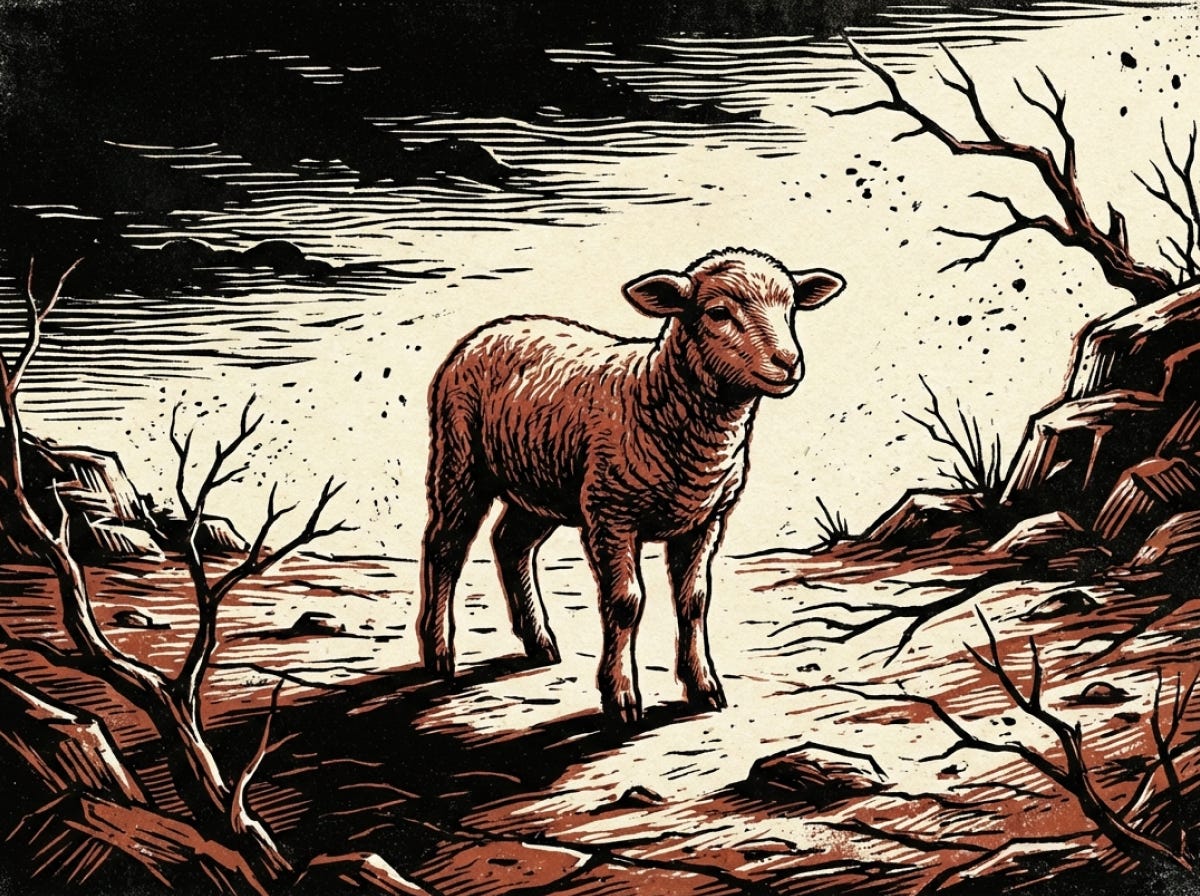
You’ve felt it, haven’t you?
The marketplace is not neutral territory. There’s a logic operating there—an economy of extraction, a vocabulary of conquest, a set of assumptions about what business is for. And when you’ve tried to operate differently—when you’ve refused the manipulation, when you’ve told the truth about your product’s limitations, when you’ve let the customer walk away unpressured—you’ve felt it: you are prey among predators.
The wolves know how this works. They’ve mastered the game. They understand the psychological triggers, the conversion optimization, the urgency manufacturing. They speak fluently the language of acquisition and capture and lifetime value extraction. And they look at your scruples the way a wolf looks at a lamb: as weakness to be exploited.
This feeling is not paranoia. It’s recognition.
The Nature Jesus Named
When Jesus sent out the seventy-two, He named it plainly: “Go your way; behold, I am sending you out as lambs in the midst of wolves” (Luke 10:3).
Notice what He didn’t say. He didn’t say, “I am sending you out as smarter wolves.” He didn’t say, “I am sending you out as wolves with better values.” He didn’t say, “I am sending you out as wolves who will eventually outcompete the other wolves through superior ethics.”
He said lambs. Among wolves.
This is nature, not tactics. The lamb doesn’t beat the wolf by becoming a better predator. The lamb is a fundamentally different kind of creature—and Jesus sends His people into hostile territory as exactly that. Vulnerable. Dependent. Blessing-first. Free to be rejected.
And here is the mystery that defies every worldly calculation: the kingdom advances through the lambs. Not despite their vulnerability, but through it. The seventy-two returned with joy: “Lord, even the demons are subject to us in your name!” (Luke 10:17). Something was happening through their lamb-posture that wolf-tactics could never accomplish.
How I Learned to Hunt
This is what I missed for twenty years.
I knew the marketplace was competitive. I thought the answer was to compete better—with integrity, yes, but still to play the game well enough to win. I learned the frameworks. I optimized the funnels. I told myself I was being strategic, being excellent, being a good steward of the opportunities God had given.
I had no idea I was slowly becoming a wolf.
It happened by degrees. A little manufactured urgency here—not lying exactly, just... shaping perception. A pricing strategy that extracted maximum value rather than served genuine need. A marketing message that found the customer’s insecurity and pressed on it. Each compromise small enough to rationalize, invisible enough to ignore.
The companies succeeded. Revenue grew. The metrics said I was winning. But there was a cost I didn’t name, even to myself. Every time I created false urgency to close a sale, something calcified. Every time I positioned my offering to exploit insecurity rather than address need, something grew harder. I was still a lamb, technically. I still believed the right things, held the right values, prayed before client calls.
But I was learning to hunt.
Then one morning, reading a competitor’s sales page, I felt something uncomfortable. The manufactured urgency. The psychological pressure points. The scarcity language. I was offended by it—until I opened my own website in another tab.
It was the same playbook. Different words, same wolf.
The question that surfaced still haunts me: What kind of creature have I become?
A Different Logic
What does it mean to be a lamb in the marketplace?
It’s not about how to baptize wolf-tactics with Christian vocabulary—how to extract more efficiently while feeling better about it, how to manipulate with a cleaner conscience, how to build Babylon’s towers while singing Zion’s songs.
It’s about something more radical: operating by an entirely different logic. The logic of a kingdom that is breaking into the present age. The logic of sent people who carry no moneybag but offer peace to every house. The logic of those who are free to shake the dust from their feet because their names are written in heaven and no earthly rejection can touch that.
This will cost you. Jesus was clear-eyed about where He was sending them: among wolves. The lambs don’t have the wolves’ advantages. Your growth will likely be slower. Your conversion rates lower. Your margins thinner. The wolves will look at your approach and see weakness—and by their metrics, they’ll be right.
But their metrics aren’t the final measure.
“Nevertheless,” Jesus told the returning seventy-two, “do not rejoice in this, that the spirits are subject to you, but rejoice that your names are written in heaven” (Luke 10:20).
Even in success—especially in success—the lamb’s joy is anchored somewhere the wolves can never reach. Identity secured before outcomes. Election preceding results. Names written in heaven before a single sale is made.
This is freedom. This is liberty.
The wolf must succeed in the marketplace. Everything depends on it—identity, security, worth. The wolf cannot let the deal walk away because the wolf’s soul is in the deal.
But the lamb? The lamb already has what the wolf is hunting for. The lamb’s name is already written. The lamb’s identity is already secured. The lamb is free to offer, free to serve, free to be rejected, free to shake the dust and move on—because nothing in the marketplace can touch what matters most.
This is not weakness. This is the most radical freedom available in commerce.
Babylon’s Success and Its End
The wolves have a coherent system. It works—by its own measures. The manipulation converts. The pressure closes sales. The extraction accumulates wealth. If you measure success the way Babylon measures it, the wolves are winning.
But Babylon falls (Revelation 18). And when it falls, the merchants weep over their lost commerce—because their success was built on what cannot last. John’s vision shows them mourning: “all your delicacies and your splendors are lost to you, never to be found again!” (Revelation 18:14). The list of their cargo is revealing—gold, silver, jewels, fine linen, and “slaves, that is, human souls.” (Revelation 18:13). The wolf’s economy trades in everything, including people.
The lamb’s success is different. It’s measured in faithfulness. It’s anchored in heaven. It operates by a logic that looks like foolishness to the wolves—and accomplishes what their power never could.
Jesus knew where He was sending you. He sends you anyway. He sends you as a lamb—not because He’s naive about wolves, but because the kingdom advances through vulnerability that trusts in God rather than power that trusts in self.
Building as Lamb
What does this look like in practice?
It looks like building differently. Not just with better ethics as constraint, but with an entirely different purpose—service rather than extraction, blessing rather than accumulation.
It looks like treating customers as neighbors to love rather than targets to convert. Not “how do I get them to buy?” but “how do I genuinely serve them, even if that means telling them this isn’t right for them?”
It looks like marketing that bears truthful witness rather than crafted manipulation. Words matching reality. No manufactured urgency, no false scarcity, no exploitation of cognitive biases.
It looks like pricing that seeks justice rather than extraction. Fair exchange of value. Leaving money on the table when taking more would be unjust.
It looks like holding whatever you build with open hands—steward, not owner. Free to receive, free to release. Your identity separate from the outcome.
It looks like rest. Regular stopping that declares your provision comes from God, not ceaseless labor. Sabbath as resistance against the empire’s economy.
It looks like contentment. Recognizing “enough” when you have it. Escaping the tyranny of endless more.
It looks like community. Not solo enterprise but embedded life—sharing burdens, celebrating victories, meeting needs, providing accountability.
The Freedom That Looks Like Weakness
I’m still learning this. The panic still rises sometimes. The fists still try to close. After twenty years of hunting, the instincts run deep. But I’m learning to recognize it faster, to name what I’m grasping for, to cry out for grace.
And I’m learning that the lamb’s way isn’t weakness. It’s the only path to what I was actually looking for—freedom that doesn’t depend on the next sale, identity that doesn’t rise and fall with the quarterly report, rest that isn’t just exhaustion’s pause before the next sprint.
The wolves will tell you this is naive. The market will reward them, at least in the short term. You’ll watch them hit milestones while you’re still finding your footing. You’ll wonder if you’re being faithful or just foolish.
But remember what Jesus told the seventy-two. They returned with joy—”Lord, even the demons are subject to us in your name!” They had seen something happen through their vulnerability that force could never accomplish.
And Jesus’s response wasn’t “yes, celebrate your power.” It was: “Nevertheless, do not rejoice in this, that the spirits are subject to you, but rejoice that your names are written in heaven.”
Even their success wasn’t the point. The point was whose they were—and that nothing in the mission, successful or not, could touch that.
Go your way.
Carry no moneybag.
Offer peace to every house.
Rejoice that your name is written in heaven.
You are sent.
Subscribe to receive reflections on faithful business in a predatory marketplace.
Another great post! To me, I want to remember that in a Kingdom economy we seek to multiply goodness instead of gold. One thing I would like for you to unpack is that in the rest of the verse that Jesus tells his followers to be "be as shrewd as snakes and as innocent as doves." It seems that our innocence should be marked by shrewdness and tenderness: an almost paradoxical tension.