

How Babylon Sees It Differently
I was reading a business book that made perfect sense on every page—and that's what terrified me. The advice wasn't wrong exactly. It was a worldview.

I was reading a business book last year—a bestseller, well-reviewed, recommended by three people I respect—and something shifted on page forty-seven.
The author was explaining how to evaluate potential customers. He used the word “qualify”—which customers are worth your time, which ones aren’t, how to move quickly past the ones who won’t produce sufficient return. The framework was elegant. It had a matrix. It had metrics. It made perfect sense.
And that’s what terrified me.
Not because the advice was wrong. Much of it wasn’t. Knowing which customers you can actually serve well is genuine wisdom. Having criteria for where to invest your limited time is stewardship. The mechanics were sound.
What terrified me was the assumption underneath. The framework didn’t just help you serve better—it taught you to see people as inputs in a system. Qualified or unqualified. Worth your time or not worth your time. The matrix had columns for revenue potential and referral likelihood, but no column for “is this person in need?” No row for “could I serve them even if there’s no return?”
I put the book down and stared at the ceiling.
This wasn’t a bad book. This was a coherent book. Every piece fit together—the qualifying framework connected to the pricing strategy connected to the growth model connected to the exit plan. It was a complete vision of what business is for, how value works, what success looks like. A worldview, not just a collection of tactics.
And I realized: I’d absorbed a dozen books just like it. Each one had given me a tool. Together, they’d given me a theology.
The Merchants’ Tears
The world’s marketplace has an economy too. Not random, not stupid, not entirely wrong—but built on different foundations and aimed at different ends.
John saw it in vision:
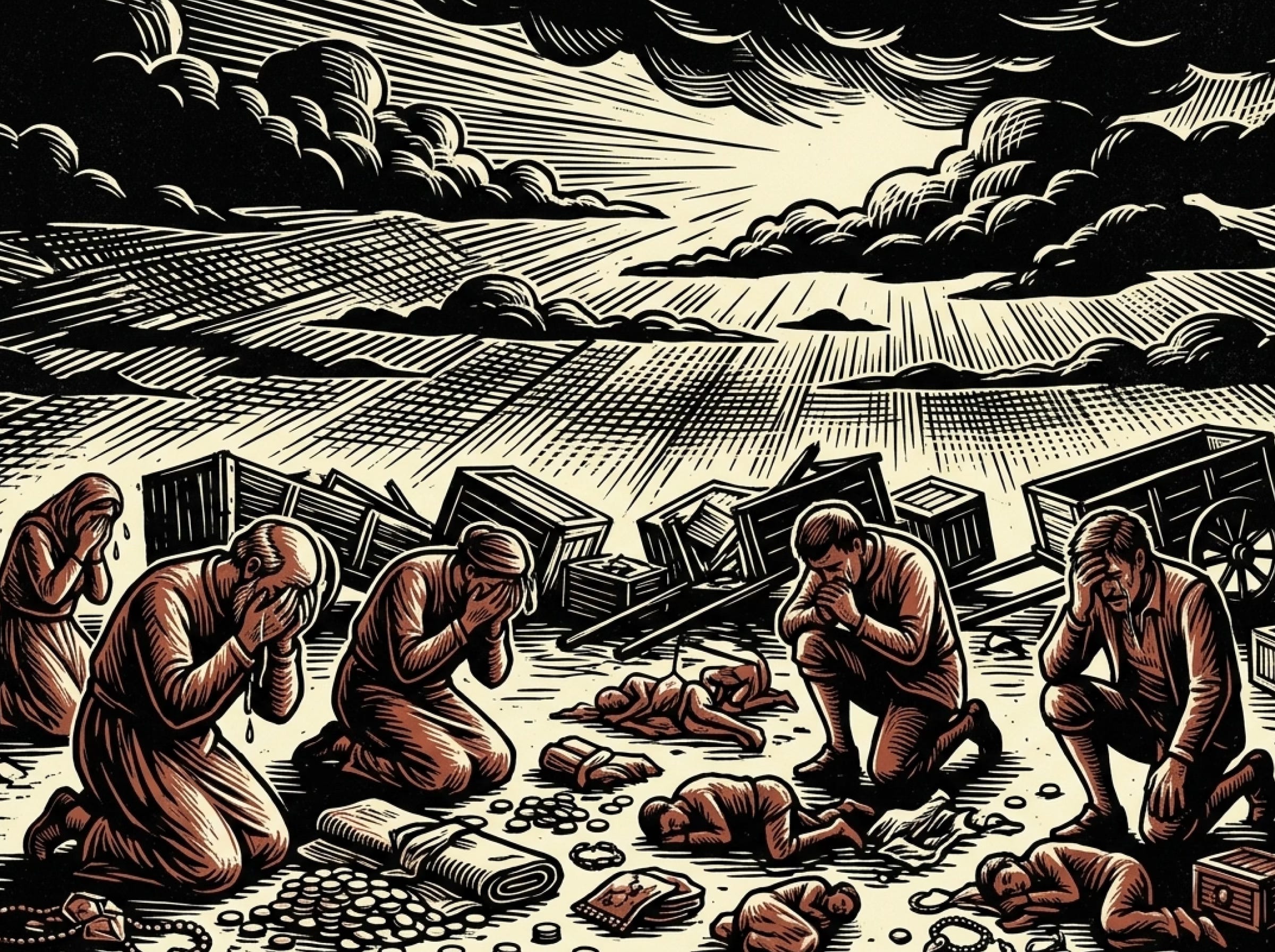
“The merchants of the earth weep and mourn for her, since no one buys their cargo anymore, cargo of gold, silver, jewels, pearls, fine linen, purple cloth, silk, scarlet cloth, all kinds of scented wood, all kinds of articles of ivory, all kinds of articles of costly wood, bronze, iron, and marble, cinnamon, spice, incense, myrrh, frankincense, wine, oil, fine flour, wheat, cattle and sheep, horses and chariots, and slaves, that is, human souls” (Revelation 18:11–13).
Read the list slowly. It starts with luxury goods—gold, silver, jewels. Then textiles. Then exotic materials. Then spices and incense. Then staples—wine, oil, flour, wheat. Then livestock. Then horses and chariots.
And then: slaves, that is, human souls.
The list descends. From precious metals to people. The system trades in everything, and by the time it reaches the bottom of its inventory, it’s trading in human beings—and John makes sure you see it by adding that editorial gloss: “that is, human souls.” Not just bodies. Souls.
This is Babylon’s economy at full expression. Commerce divorced from God’s purposes, success measured by wealth, the entire created order—including people—treated as commodity. And the merchants weep when it falls. Not because people suffered. Because no one buys their cargo anymore.
They mourn their lost revenue.
The system works—by its own measures. The manipulation converts. The pressure closes. The extraction accumulates. Babylon’s economy has made its merchants rich. The question is what it costs, and whom.
The Water You’re Swimming In
“Do not love the world or the things in the world,” John wrote. “For all that is in the world—the desires of the flesh and the desires of the eyes and pride of life—is not from the Father but is from the world. And the world is passing away along with its desires” (1 John 2:15–17).
To navigate faithfully, you need to understand the water you’re swimming in. The world’s approach to business isn’t a random collection of bad tactics. It’s a coherent system built on particular assumptions. Understanding those assumptions helps you recognize the patterns when you encounter them—in whatever package they come.
And it starts with identity.
You’re at a networking event. Someone asks what you do. You answer—and watch their eyes. Are they leaning in or scanning for the next conversation? The calculus is instant and merciless: What have you built? How big? How fast? The room sorts itself into hierarchies of achievement before the appetizers arrive.
Track record matters—of course it does. Past performance is real data, and credentials signal competence. But the world doesn’t treat achievement as information. It treats it as identity. You become someone by accomplishing something. Before that, you’re invisible. And once your achievements define you, stopping means disappearing. The pressure to perform isn’t strategic anymore. It’s existential.
And if your identity depends on achievement, then you need to protect what you’ve achieved. That’s the next domino: security from accumulation. The rich fool in Jesus’s parable had it figured out: “I will tear down my barns and build larger ones, and there I will store all my grain and my goods. And I will say to my soul, ‘Soul, you have ample goods laid up for many years; relax, eat, drink, be merry’” (Luke 12:18–19). Accumulate enough and you’re insulated—from need, from dependence, from the terrifying vulnerability of not having a cushion between you and catastrophe.
Building financial margin is wisdom. Proverbs commends the ant who stores in summer. But notice the fool’s logic: security as destination. The number that will finally let him rest. You know the number. You’ve had one. And you know what happened when you reached it—it moved. Six months of runway became twelve, twelve became twenty-four, and somehow it’s never enough. “He who loves money will not be satisfied with money” (Ecclesiastes 5:10). The ceiling keeps rising because the hunger isn’t for money. It’s for a security that money cannot provide.
Now: if your identity is built on achievement and your security on accumulation, how do you see the people you serve?
The vocabulary tells on itself. Capture. Acquisition. Conversion. Targets. Listen to those words—they’re not neutral. They’re the language of extraction, not service. Customers become leads to qualify, wallets to open, lifetime value to maximize. The question driving every interaction shifts from “How can I help?” to “What can I get?” Understanding customer economics is legitimate—knowing acquisition costs and lifetime value helps you make sustainable decisions. But when the relationship itself becomes fundamentally about extraction, you’ve stopped serving neighbors and started harvesting resources.
And extraction at scale demands growth. More revenue, more customers, more reach—”go big or go home.” Growth can indicate health, and reaching more people can mean serving more neighbors. But Babylon doesn’t treat growth as a sometimes-good. It treats growth as the only good. The possibility that faithful stewardship might mean staying small, staying local, staying limited—that not every mustard seed is meant to become the largest tree—is never seriously considered. The quiet shame attached to choosing “enough” tells you everything about what the system actually worships.
Follow the chain to its end: if identity comes from achievement, security from accumulation, customers exist for extraction, and growth is the unquestioned goal—then whatever works is justified. Conversion optimization without ethical examination. Psychological manipulation presented as “best practices.” The reasoning: “What’s the harm if it works?” Effectiveness matters—you should care whether your methods actually serve people. But when effectiveness becomes the only criterion, ethics shrink to mere constraint. The question stops being “Is this good?” and becomes “Does this convert?” And by the time you’re asking that question, the dominoes have already fallen.
Baptized Babylon
Here’s something crucial: the most dangerous form of these assumptions isn’t naked Babylon. It’s Babylon dressed in Christian vocabulary.
There’s a whole genre of “Christian business” content that sounds different but teaches the same thing. The vocabulary changes—”stewardship” instead of “ownership,” “kingdom impact” instead of “building an empire,” “God’s blessing” instead of “financial freedom”—but the underlying assumptions remain untouched.
I’ve consumed more of it than I’d like to admit. Books that promised “biblical” success but measured success by the same metrics the world uses: revenue, audience, growth rate. Frameworks with Bible verses attached but identical in structure to secular frameworks. The promise that kingdom principles are actually more effective for building wealth—God’s way is the best business strategy.
The subtle prosperity gospel doesn’t always promise a private jet. Sometimes it promises that faithfulness will make your business more profitable, your audience larger, your metrics more impressive. That if you just follow God’s principles, success (defined exactly the way Babylon defines it) will follow.
Here is the test: Does this content challenge the world’s assumptions, or just baptize them?
Does it prepare you for the possibility that faithfulness might mean slower growth, thinner margins, less impressive metrics—or does it promise that faithfulness will make you more successful by Babylon’s own measures?
Does it ask “What has God called you to?” or only “What’s the biggest opportunity?”
Does it wrestle with the lamb’s vulnerability—the real cost of operating differently in wolf territory—or does it promise that lambs who follow the right principles will actually outperform the wolves?
Babylon in Christian clothing is more dangerous than naked Babylon because it’s harder to recognize. You can follow it faithfully and end up in exactly the same place as someone following secular advice—just with more Bible verses along the way and a cleaner conscience about the extraction. The vocabulary sounds right while the operating system remains unchanged.
The Fruit of the System
“Come now, you who say, ‘Today or tomorrow we will go into such and such a town and spend a year there and trade and make a profit,’” James wrote. “Yet you do not know what tomorrow will bring... Instead you ought to say, ‘If the Lord wills, we will live and do this or that.’ As it is, you boast in your arrogance” (James 4:13–16).
The system is coherent within its own framework. If identity comes from achievement, of course you’re driven to achieve. If security comes from accumulation, of course you pursue more. If customers are resources, of course you optimize extraction. Each assumption follows logically from the premises.
But the premises are wrong. Wrong about what humans are. Wrong about what we’re for. Wrong about what business is for. And the wrongness produces fruit.
Paul saw it clearly: “Those who desire to be rich fall into temptation, into a snare, into many senseless and harmful desires that plunge people into ruin and destruction. For the love of money is a root of all kinds of evils. It is through this craving that some have wandered away from the faith and pierced themselves with many griefs” (1 Timothy 6:9–10).
Temptation. Snare. Senseless desires. Ruin. Destruction. Pierced with many griefs.
This is not moralistic hand-wringing. This is diagnostics. Paul is describing what actually happens when you build your life on Babylon’s assumptions. The anxiety that never resolves—because there’s never enough to feel secure. The relationships that feel transactional—because you’ve been trained to evaluate people by what they can produce. The success that feels hollow—because the identity it was supposed to provide keeps receding. The manipulation that sears conscience—because “whatever works” slowly erodes the capacity to feel conviction at all.
The rich fool got his barns. He got his years of ease—at least he thought he did. “But God said to him, ‘Fool! This night your soul is required of you, and the things you have prepared, whose will they be?’” (Luke 12:20).
Whose will they be?
The system produces ruin. But it looks compelling—which is why you need to recognize it.
The First Freedom
I want to be careful here. This is not an anti-business argument. It’s not anti-learning, anti-growth, or anti-excellence. Track record matters. Financial sustainability matters. Understanding your customer matters. Growing when growth serves people matters. Effectiveness matters.
The kingdom economy described in the last article isn’t the absence of these things. It’s the redemption of them—each one taken up, purified of idolatry, and put to its proper use in service of God and neighbor.
What I’m naming is something more specific: the assumptions underneath the tactics. The invisible theology that business culture teaches you without announcing it as theology. The water you’re swimming in that shapes you before you notice you’re wet.
And naming it is the first freedom.
You can’t swim differently until you see the water. You can’t challenge assumptions you haven’t identified. You can’t resist formation you don’t recognize as formation.
So this week, pay attention. When you read business content, listen beneath the tactics for the assumptions. When you feel the pull toward a decision, ask: which economy is this coming from? When the anxiety rises about metrics or growth or competitive positioning, notice: whose voice is that?
Not to condemn yourself. Not to quit reading business books. Just to see.
Recognition is the first freedom. And freedom—the lamb’s freedom, grounded not in market position but in a name written in heaven—is what the next article is about.
What assumption from Babylon’s economy have you absorbed without realizing it? Which one is shaping your decisions right now?
Subscribe to receive reflections on faithful business in a predatory marketplace.
"This was a coherent book."
The discernment to recognize that coherence ≠ Truth is something I hope and pray more people receive. This was a foundational point the Lord made with me when He saved me, and I am so thankful for that.
Additionally, to your point of "there’s a whole genre of “Christian business” content that sounds different but teaches the same thing...." I find that often any content/platform/business that is over-peppered with Proverbs in their messaging and framework is just the world's wisdom rebranded as "Christian" or "Kingdom."
They seem to miss the part in the Bible where Solomon "did evil in the sight of the Lord," never repents (as recorded in scripture), and only at the END of his life figures out the Reality of Wisdom: to paraphrase it, "Fear God and do what He says" (Ecc 13:12).
And that is what Christ has done perfectly, who "became for us wisdom from God..." (1 Cor 1:30)
Excellent article! Thank you!